
The Shocking Reality of Doing the "Right" Thing
I still remember the exact moment my stomach dropped into my shoes. After months of skipping vacations, eating cheap homemade meals, and working late nights, I finally saved enough money to pay off my car loan completely. I marched into the bank feeling like an absolute champion, ready to hand over the final check and claim my freedom. But instead of a congratulatory handshake, the bank teller handed me a receipt with a massive, unexpected fee attached to my balance. I was entirely confused and honestly felt deeply betrayed by the system. My hard work was actually being punished, and I was expected to pay extra money just for being financially responsible.
Imagine waking up every single day to a silent financial nightmare. You are an honest, hardworking person who has made massive sacrifices just to escape the crushing weight of monthly payments. For months, or even years, you have actively cut back on your lifestyle, hoping to finally breathe easily and experience true financial freedom.
You probably thought you were playing the financial game perfectly. You followed the golden rule of personal finance by aggressively eliminating your debt well ahead of schedule. But instead of a victory lap, the bank slaps you with a hidden fee known as a prepayment penalty. Just like that, your hard-earned peace of mind is instantly destroyed.
This scenario feels completely backward and, quite frankly, incredibly unfair. From childhood, we are taught a very simple lesson: being in debt is a burden, and paying it off as quickly as possible is the ultimate goal. When you finally achieve that major milestone, getting penalized for your financial responsibility feels like a harsh slap in the face.
Why does this happen? Financial institutions structure their contracts based on projected interest earnings over a set period. When you pay off your balance early, they lose out on that expected profit. This is exactly why checking for early repayment clauses is critical before signing any paperwork. In fact, overlooking the fine print is a massive pitfall, and learning how to avoid common loan application mistakes can literally save you thousands of dollars down the road.
The mental toll of navigating these hidden traps is honestly exhausting. You sit at your kitchen table staring at the confusing paperwork, wondering exactly where you went wrong. You ask yourself how you managed to miss such a massive trap.
This sudden financial blow creates a deep sense of anxiety and breeds a lasting distrust toward financial institutions. You simply wanted to secure your family's future, but instead, you are forced to empty your pockets even further to satisfy an obscure clause.
Many borrowers lose sleep over these unexpected fees, feeling hopelessly trapped in complex contracts they never fully understood. Here is why prepayment penalties are so deeply frustrating for the average borrower:
- They penalize good behavior: You are quite literally being charged extra for being financially responsible, organized, and proactive.
- They hide in plain sight: These restrictive fees are almost always buried deep within the complex, overwhelming jargon of your lending agreement.
- They complicate smart borrowing: The fear of hidden penalties makes it much harder to make strategic decisions, such as choosing between fixed and variable rates, since different loan structures carry entirely different penalty risks.
Ultimately, the pure, well-deserved joy of becoming debt-free is completely stolen by greedy institutional rules that make zero sense to the average person. It is a harsh reminder that in the modern financial system, even doing the right thing can sometimes come with an unexpected price tag.
Myth vs. Reality: The Banking Business Model
Before we explore the exact reasons behind this frustrating situation, we need to clear up a massive misunderstanding. There is a huge gap between what we think banks do and how they actually operate.
The Myth: Banks want you to pay back the money as quickly as possible so they can be safe and secure.
The Reality: Banks view your loan as an investment, and they want you to stay in debt for as long as possible to maximize their profits.
You have to think about your loan from the perspective of the lender. They are not doing you a favor by handing you a stack of cash. They are buying a steady stream of income, which comes in the form of your monthly interest payments.
When you sign a five-year contract, the bank calculates exactly how much profit they will make over those sixty months. They rely on that specific amount of money to pay their employees, keep their lights on, and report profits to their shareholders.
If you suddenly show up three years early with a giant check to clear the balance, you are effectively cutting off their income stream. You are breaking the profit projection they made when they first approved your application.
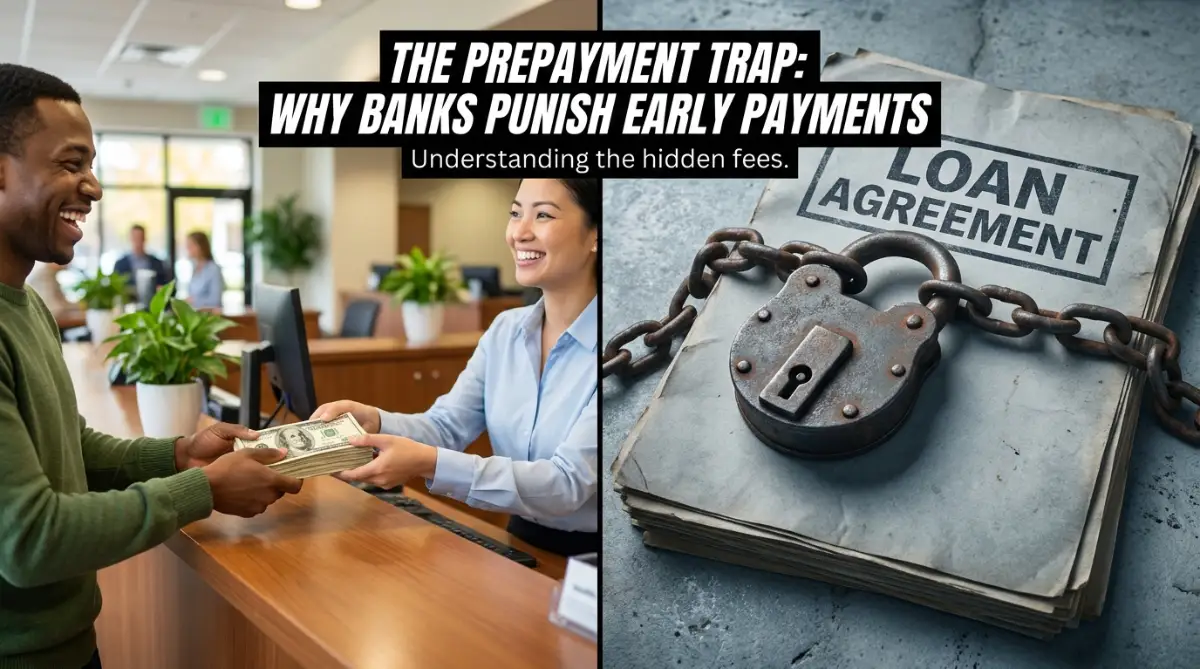
Understanding the Hidden Prepayment Trap
Because banks hate losing their guaranteed profit, they invented a financial safety net for themselves. This safety net is specifically designed to make sure they get paid, no matter what you do.
They write a special clause into your contract that guarantees a minimum amount of interest. If you try to escape the interest payments by paying off the principal early, the penalty kicks in to replace the bank's lost profit.
Pro Tip: I learned the hard way that you should never assume a standard contract is completely safe. My biggest mistake was trusting the smiling loan officer instead of taking ten minutes to read the fine print myself. Now, I refuse to sign any document until I specifically ask them to point out the prepayment clauses to me.
Essentially, the bank is telling you that you signed up to pay a certain amount of interest, and you are going to pay it whether you keep the loan or not. It is a harsh business tactic that directly penalizes your financial success.
Here is a quick breakdown to make this concept extremely easy to grasp:
Imagine you agree to rent an apartment for a full year. After six months, you decide to buy a house and want to move out early. Your landlord will likely charge you a heavy fee for breaking the lease because they expected a full year of rental income. Your loan works the exact same way.
[Bold Intro Text to Grab Attention:]
If you are feeling completely lost about how interest and penalties actually work behind the scenes, this quick visual breakdown will clear up all your confusion instantly.
The Two Faces of Early Payoff Fees
Not all banks punish you in the exact same way. The financial world has created a few different methods to extract this lost profit from your wallet.
Depending on the specific type of loan you have, you might encounter different styles of penalties. Let us break down the two most common types so you know exactly what to look for.
Hard Penalties vs. Soft Penalties
If your contract contains a hard penalty, you are heavily restricted. A hard penalty means you will be charged a massive fee if you pay off the entire loan early, or even if you sell the property attached to the loan.
You cannot escape a hard penalty simply by moving or selling your car. The bank will take their fee directly from the sale money before you see a single penny of it.
On the other hand, a soft penalty is slightly more forgiving, but still incredibly annoying. A soft penalty only applies if you try to refinance the loan with another lender to get a better interest rate.
If you actually sell the house or the car under a soft penalty rule, the bank usually waives the fee. They just want to stop you from taking their business to a competitor.
Here is a simple comparison to help you remember the difference:
The Notorious "Rule of 78" Explained
When dealing with personal loans and car financing, there is a very specific, almost invisible mathematical trick lenders use against you. It is called the Rule of 78, and it is entirely designed to protect the bank's profits during the early stages of your loan.
Normally, you would assume that every monthly payment you make is split evenly between the principal balance and the interest. You think you are slowly chipping away at the actual debt from day one.
The Rule of 78 completely destroys that assumption. Instead of splitting the interest evenly across the life of the loan, the bank front-loads almost all of the interest into your first few months of payments.
To understand this easily, imagine ordering a massive pizza with a group of friends. Instead of everyone taking an equal slice, the bank steps in and takes half the pizza immediately. You and your friends are left fighting over the remaining small slices for the rest of the night.
Because the bank takes all their interest upfront, paying off your loan early does not actually save you much money. You have already paid them their required profit during your first year of payments.
If you decide to write a check to clear the balance in year two, you are mostly just paying back the raw principal. The bank happily accepts the money because they already secured their interest earnings months ago.
This is why many people are completely shocked when they ask for a payoff quote. They expect the remaining balance to be much lower, completely unaware that their early payments were only covering the interest charges.
Mortgage Realities: Yield Maintenance
If you are dealing with commercial real estate or very large mortgages, the penalties become even more complicated. The banks use incredibly complex formulas to make sure they do not lose a single dime.
One of these methods is called Yield Maintenance. This is a fancy banking term that essentially means they want to maintain their expected yield, or profit, no matter what happens.
If interest rates drop in the general market, and you try to pay off your mortgage early to get a better deal, the bank calculates exactly how much money they will lose. They then charge you that exact amount as a penalty fee.
They use advanced math to guarantee they make the same amount of money whether you pay them over twenty years or hand them a giant check tomorrow. It removes all the financial benefit of trying to outsmart the current market rates.
How to Spot the Trap Before You Sign
The good news is that banks cannot legally hide these penalties from you entirely. They are forced by law to disclose these rules, but they often bury them deep inside boring legal documents.
In many countries, lenders are required to provide a specific disclosure form before you sign anything. This document highlights the most important numbers regarding your new debt.
You need to actively look for a section labeled "Prepayment" or "Prepayment Penalty". It will usually have a simple 'Yes' or 'No' box checked next to it.
If the 'Yes' box is checked, you need to immediately stop the process. Ask the loan officer to show you the exact page in the contract that explains how the penalty is calculated.
Do not let them rush you through the signing process. They will often point to the signature line and say it is just standard paperwork. Remember that this "standard paperwork" could cost you thousands of dollars in the future.
Scenario A vs. Scenario B: The Partial Payment Trick
Sometimes, people do not want to pay off the entire loan at once. They just want to send a little extra money every month to slowly reduce their debt faster.
Scenario A: You have a rule in your contract that allows you to pay up to 20% of your original loan balance every year without any extra fees. You send an extra hundred dollars every month, slowly eating away at the principal. The bank ignores this because it stays under their penalty limit.
Scenario B: You get a big bonus at work and decide to pay off 50% of the loan in one single afternoon. Because you crossed that 20% threshold, the bank immediately triggers the prepayment penalty and charges you a massive fee.
You must read your specific contract to find out what your exact limits are. Many lenders will allow you to make small additional payments as long as you do not try to wipe out the debt completely.
If you know your limits, you can carefully navigate around the penalty zone. You can slowly and safely reduce your debt without waking up the sleeping giant of banking fees.
The Motivation Behind Early Payments
Despite these annoying traps, we cannot ignore the incredible emotional and financial relief that comes from living without debt. Eliminating your monthly obligations frees up your income to build actual wealth.
When you do not owe the bank a portion of your paycheck every month, you can finally start investing in your own future. You can build an emergency fund, save for a comfortable retirement, or take that dream vacation without feeling guilty.
However, jumping blindly into a massive early payment without checking the rules is a dangerous game. You have to balance your desire for freedom with a logical understanding of your legal contract.
Sometimes, doing the math reveals a painful truth. If the penalty fee is larger than the interest you would save by paying early, it is actually smarter to just keep making the regular monthly payments.
You have to take your emotions completely out of the equation. Do not let your hatred of debt blind you to the mathematical reality of your specific situation.
Protecting Your Hard-Earned Money
Your money is meant to serve you and your family, not to line the pockets of massive financial institutions. Taking the time to understand these hidden rules is the best way to protect your financial health.
Next time you sit down to finance a car, a home, or a personal project, you will have the knowledge to protect yourself. You can look the lender in the eye and negotiate a contract that actually benefits your future.
Always remember that everything in a financial contract is negotiable before you sign your name. If a lender insists on a harsh prepayment penalty, you have the ultimate power to simply walk away and find a better bank.
Smart Strategies to Outsmart Bank Fees and Keep Your Money
Now that we fully understand why financial institutions try to penalize our success, it is time to fight back. You do not have to just sit there and accept these ridiculous hidden charges. There are completely legal, highly effective methods to bypass these traps and protect your wallet.
The biggest secret in the banking industry is that most contracts actually offer small windows of opportunity for early payments. You just have to know exactly where to look and how to ask the right questions. The average borrower simply hands over extra cash and hopes for the best, which is exactly what the lenders want you to do.
Instead of guessing, you need to take control of how your money is processed. When you send an extra payment, banks will automatically apply it toward your future interest charges first. They do this to secure their profits, completely ignoring the actual principal balance of your debt.
To stop this from happening, you must specifically request a "principal-only payment" every single time you send extra money. You can usually do this by checking a specific box on your online banking dashboard or writing it clearly on the memo line of your physical check.
Think of it like handing a twenty-dollar bill to a waiter at a restaurant. If you do not explicitly say it is to cover the bill, they might just assume you are giving them a massive tip. According to the Consumer Financial Protection Bureau, federal guidelines give you the right to direct exactly how your extra funds are applied, so you must use that power.
By forcing the bank to apply the extra money directly to the principal, you reduce the core amount you owe. Because your daily interest is calculated based on that core amount, lowering the principal automatically shrinks the interest you pay the following month.
Timing is Everything When Escaping Debt
Another powerful tactic is to carefully monitor the specific penalty timeline outlined in your paperwork. Most prepayment penalties do not last for the entire duration of your contract. They usually expire after a set period, like the first twenty-four or thirty-six months.
If you get a massive tax refund and want to wipe out your debt, check your contract timeline first. If you notice that your penalty clause expires in just two months, it is absolutely worth waiting. You can put that extra cash into a standard savings account for sixty days, wait for the penalty window to close, and then make your massive payment penalty-free.
You also need to understand how different lending structures affect your strategy. If you are comparing smart borrowing: how to choose between fixed and variable rates, you will quickly notice that fixed-rate contracts usually carry much harsher prepayment rules. Lenders use these strict rules to lock in their long-term profits when they promise you a stable rate.
If you are currently trapped under a heavy penalty, a smart workaround is to look into refinancing options. Sometimes, you can refinance your existing balance with a completely different lender who offers better terms and zero early payment fees.
However, you have to do the math carefully here. You need to make sure the cost of opening the new account does not outweigh the penalty you are trying to avoid. Consulting legal definitions on sites like Cornell Law School's Legal Information Institute can help you understand exactly how these amortization structures and fees are legally defined before you attempt to refinance.
Pro Tip: I always set a calendar reminder on my phone for the exact day my prepayment penalty expires. When I bought my last car, I slowly built up a special savings fund on the side. The very day the penalty clause dropped off my contract, I transferred all those savings to the lender and wiped out the balance completely without paying them an extra cent.
The Heartbreaking Pitfalls You Must Avoid
Trying to become debt-free is a highly emotional journey, and our emotions often push us into making terrible financial decisions. When we get sick and tired of making monthly payments, we tend to rush the process without thinking things through. This blind rush is exactly how honest people end up falling into massive financial holes.
One of the most dangerous mistakes you can make is assuming that verbal promises mean anything in the banking world. I have heard countless stories of people asking their local branch manager if there is a fee for paying early. The manager smiles, says "No, you should be fine," and then the system automatically charges the fee anyway.
If it is not written clearly on a piece of paper and signed by both parties, it simply does not exist. Do not ever trust a casual conversation when it comes to thousands of dollars. You must read the physical documents, especially when dealing with personal unsecured loans where lenders aggressively protect their high-yield interest.
Another tragic mistake is destroying your personal safety net just to get rid of a low-interest debt. Let us say you have a small car note at a deeply discounted interest rate of three percent. You completely empty your emergency savings account to pay it off because you hate seeing the monthly bill.
The next week, your roof starts leaking or you face an unexpected medical emergency. Because you drained your cash, you are now forced to put those emergency expenses on a credit card charging twenty-five percent interest. You tried to save a few pennies and accidentally created a massive financial disaster for your family.
Understanding Opportunity Cost
This brings us to a concept called opportunity cost, which is something every smart borrower needs to understand. Before you rush to hand your extra money back to the bank, you need to look at what else that money could be doing for you.
If your lending rate is significantly lower than the current market savings rate, paying early is actually a mathematical mistake. Organizations like the National Foundation for Credit Counseling often remind consumers that maintaining a healthy cash reserve is far more important than paying off a cheap, stable debt ahead of schedule.
You also have to be incredibly careful about how sudden large payments affect your overall financial profile. If you are preparing to buy a home, rapidly paying off old accounts can sometimes cause your credit score to drop temporarily. This happens because closing an old account reduces your average credit history length.
If you are currently calculating your debt-to-income ratio for loan approval, a sudden drop in your score could completely ruin your chances of securing a mortgage. You have to look at the big picture and plan your moves carefully.
The Missing Payoff Letter Disaster
Perhaps the most frustrating mistake I see people make is sending a massive final check without requesting an official Payoff Letter first. You cannot just look at your online dashboard, see a balance of five thousand dollars, and mail them a check for exactly that amount.
Interest accrues every single day, which means your true balance changes every twenty-four hours. If you mail a check based on Monday's balance, but they process it on Thursday, you will still owe three days' worth of interest.
Because you left a tiny balance behind, the account remains active. The bank will then hit you with late fees the following month because you missed your regular payment schedule, completely unaware that you still owed twelve dollars.
To avoid this absolute nightmare, you must call the lending department and ask for an official payoff quote valid for ten to fifteen days. The Federal Reserve System outlines consumer protections that require institutions to provide these exact payout figures upon request, ensuring you can settle your accounts accurately.
Skipping this simple phone call is one of the most common loan application mistakes people make when trying to manage their finances. Always get the exact number in writing, send the payment using a trackable method, and then demand a formal letter confirming the account is closed and fully satisfied.
Your Master Plan for Financial Freedom
Navigating the complex world of banking fees does not have to feel overwhelming or scary. You just need to approach your financial agreements with a clear head and a basic understanding of how the system actually works. You now have the knowledge to see right through their clever tricks and hidden clauses.
Instead of being a passive consumer who just signs wherever the nice banker points, you are now an educated borrower. You know that banks prioritize their own profits above your financial health, and you understand the specific rules they use to enforce those profits.
The next time you sit down to finance a large purchase, you will be entirely prepared. You will actively read the fine print, hunt down the prepayment sections, and demand clear answers before you give them your signature.
If you find a lender who tries to force a harsh penalty on you, remember that you always have the power to walk away. Walking away is actually one of the main common reasons banks say no to your loan request in reverse; they lose your business because their terms are completely unreasonable.
There are plenty of competitive local credit unions and modern online banks that refuse to charge prepayment fees. Do your research, compare different offers, and only give your business to an institution that respects your desire to become debt-free.
Taking Action Today
Start by pulling out your current agreements and reading them thoroughly tonight. Find out exactly where you stand with your current debts and check if any hidden penalties are lurking in your paperwork.
If you discover a penalty clause, do not panic. Simply calculate the expiration date, adjust your saving strategy, and plan a massive payoff the moment that window closes. You are in full control of your financial destiny, and every dollar you save from bank fees is a dollar you can invest in your family's future.
I honestly believe that with a little bit of patience and the right knowledge, anyone can outsmart these greedy financial systems. My own journey taught me that paying attention to the small details is what truly builds lasting wealth, and I know you can take these exact steps to protect your hard-earned money starting today!
Clear Answers to Your Biggest Doubts
How do I know if my specific contract has an early payoff fee?
You need to grab your original paperwork and look for a specific section titled "Prepayment Disclosure" or "Early Payoff Terms." By law, lenders must check a 'Yes' or 'No' box clearly stating if a fee applies. If you lost your paperwork, you can simply call your lender's customer service line and ask them directly.
Can I negotiate a prepayment penalty away before I sign?
Yes, everything is negotiable before you put your signature on the paper. If you notice a penalty clause during the approval process, tell the loan officer you will take your business elsewhere unless they remove it. Local credit unions and smaller banks are usually very willing to waive these rules to win you as a customer.
Does paying off debt early actually hurt my credit score?
It sounds crazy, but paying off an account can cause a temporary dip in your credit score. This happens because closing the account changes your credit mix and lowers your average length of credit history. However, this small drop is usually temporary, and the financial peace of mind is almost always worth it.
What happens if I just send extra money without telling the bank?
If you do not leave specific instructions, most banks will apply your extra cash toward next month's regular payment. This means you are essentially just prepaying future interest instead of lowering your actual debt balance. Always attach a note or check a box clearly stating you want the funds applied strictly as a "principal-only payment."
Are car loans or home mortgages worse for hidden fees?
Car loans are notorious for using the Rule of 78, which front-loads your interest and makes early payments mostly pointless. Mortgages, on the other hand, often use strict timeframes, penalizing you heavily if you try to sell or refinance within the first three to five years. Both are dangerous, but they attack your wallet in completely different ways.
Disclaimer: The information provided in this article is for educational and informational purposes only and should not be construed as professional financial or legal advice. Financial contracts vary greatly depending on your location and specific lender. Always consult with a certified financial advisor or legal professional before making major decisions regarding your debts, loans, or early payoff strategies.