
The Sleepless Nights of a Crypto Investor
Let's be completely honest—waking up at 3 AM just to check if your money vanished isn't exactly a fun hobby. I used to let red charts ruin my entire week, panicking over every little market dip and panic-selling at the worst possible moments. But after losing too much sleep (and money), I finally figured out a dead-simple trick. It allowed me to step away from my phone, sleep like a baby, and watch my portfolio grow on autopilot.
This emotional rollercoaster is the harsh reality for millions of everyday people trying to navigate digital assets. You buy a coin because a friend said it was going to the moon. The moment you hit the buy button, the price drops.
You wait for it to recover, but the panic sets in. You sell at a loss, only to watch the price skyrocket a week later. It feels like a rigged game.
I still remember waking up in a cold sweat at 4 AM just to check my phone because I heard a coin I bought was crashing. My heart would race, and I ended up losing half my savings in a panic sell that same morning. It took me a long time to realize that my own emotions were my biggest enemy, not the market itself.
Why do so many smart, hardworking people fall into this trap? The answer lies in the overwhelming noise of the internet.

- Fake Social Media Gurus: Your feed is full of photoshopped screenshots showing crazy profits. These influencers sell a dream of getting rich by tomorrow morning, but they never show you the hidden risks that wipe people out.
- Overcomplicated Trading Signals: Beginners get tricked into thinking they need to read confusing charts. You end up staring at weird lines and indicators that honestly, even the guys on Wall Street get wrong half the time.
- The FOMO Trap: Fear of Missing Out makes you hit "buy" when a coin is already at its highest price. You see a random token trending online and throw your money at it out of panic, without doing a single Google search.
- Zero Risk Management: I see new investors putting their entire paycheck into one single trade all the time. When the market turns red, they have no backup plan and lose everything.
This endless stream of bad advice does more than just empty bank accounts. It deeply impacts your daily life and mental health.
- Lost Focus at Work: You cannot concentrate on your daily job because you are constantly checking price updates under your desk.
- Strained Relationships: The hidden financial losses lead to stress at home. You might find yourself snapping at your family over small things because of hidden market anxiety.
- Shattered Confidence: Every loss makes you feel less capable. You begin to believe that building wealth is impossible for someone like you.
- Complete Burnout: The 24/7 nature of digital markets means you never truly rest. The constant adrenaline spikes eventually leave you feeling completely exhausted.
The truth is, the market does not care about your emotions. It moves based on global economics, supply, and demand.
Trying to outsmart these massive forces with guesswork is a recipe for disaster. You do not lack intelligence; you simply lack a proven system.
When you do not have a clear set of rules, your emotions take the steering wheel. Fear makes you sell low. Greed makes you buy high.
This is exactly how everyday people become exit liquidity for professional traders. But it does not have to be this way.
You can step off this stressful ride today. You can take back your peace of mind while still participating in the financial future.
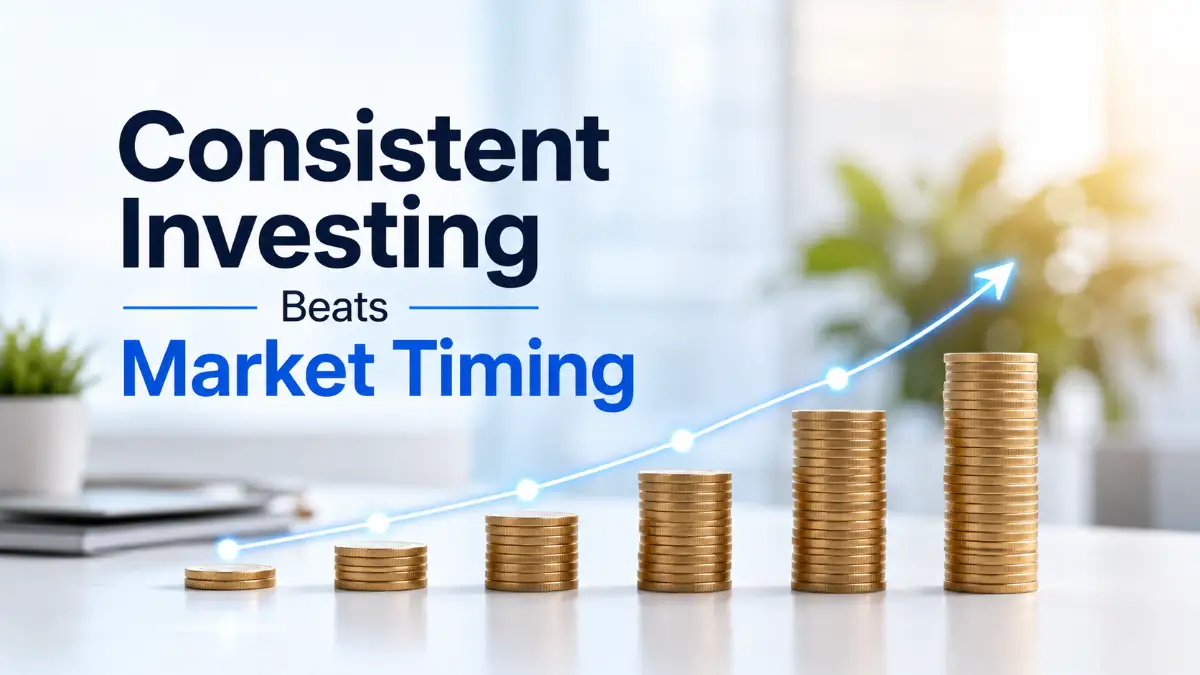
Quick Takeaways for Busy Readers
- Emotions Ruin Profits: Trying to guess when the market will go up or down is a fast track to losing your money.
- Use Dollar-Cost Averaging (DCA): Break your money into small chunks and buy regularly (like $20 a week), no matter what the price is doing today.
- Automate Everything: Set up recurring buys on your app so you never have to manually check those stressful charts again.
- Stick to Blue Chips: Only use this method on proven, high-volume digital assets. Stay far away from risky internet meme trends.
The Smart Money Secret: What is Dollar-Cost Averaging?
If trying to predict market bottoms is a fool's errand, what is the alternative? The answer is a time-tested strategy used by millionaires and institutional investors for decades.
It is called Dollar-Cost Averaging (DCA). The concept is incredibly simple, yet highly effective.
Instead of taking a large sum of money and trying to buy at the "perfect" time, you break that money into smaller pieces. You then buy a specific asset at regular time intervals, no matter what the price is doing .
If you have $1,000 to invest, you do not spend it all on a Tuesday afternoon. Instead, you might invest $100 every week for ten weeks.
Sometimes you will buy when the market is high. Other times, you will buy when the market has crashed.
Over time, the average cost of your investment balances out. You completely remove the stressful need to predict the future.
Quick Look: The DCA Math in Action
To show you exactly why I love this method, look at how a simple $50 weekly investment plays out during a nasty market crash:
- Week 1 (Price $100): You spend $50 -> You get 0.5 coins.
- Week 2 (Price $50): You spend $50 -> You get 1.0 coin.
- Week 3 (Price $25): You spend $50 -> You get 2.0 coins.
- The Result? Instead of crying over the crash, you just bought 3.5 coins for only $150. If you bought it all in Week 1, you would only have 1.5 coins. The math just makes sense!
Expert Insight: The Psychology of Winning
"The best investors are not those who can predict the future. The best investors are those who create a system that protects them from their own human emotions."
Let us break down how you can actually apply this in your own life. Here is a clear, actionable guide to building your own stress-free investment machine.
Step 1: Shift Your Mindset Away from Timing
The very first thing you must do is accept a hard mathematical truth. Nobody can consistently time the market.
Even supercomputers with endless data points get it wrong. When you accept this fact, a massive weight lifts off your shoulders.
You no longer have to worry about whether today is a "good day" to buy. Every day that matches your schedule is a good day.
Imagine you are going to the grocery store to buy coffee. You buy one bag of coffee every single week because you need it for your mornings.
Some weeks, the coffee is on sale for $5. Other weeks, there is a shortage, and it costs $10.
You do not stop drinking coffee. Over the whole year, you end up paying a very reasonable average price for your daily cup.
This is exactly how you should treat your digital assets. You are accumulating a long-term position, not looking for a quick flip.
Myth vs Reality
- The Myth: You need a lot of money and perfect timing to make a profit in crypto.
- The Reality: Small, consistent purchases over a long period build massive portfolios, safely and quietly.
Step 2: Establish Your Personal Math
Now that your mindset is correct, we need to look at the actual numbers. How much should you invest, and how often?
This step requires complete honesty about your personal finances. You should only use money that you will not need for the next three to five years.
If you need the money for rent next month, it does not belong in the market. The power of this strategy relies on giving your assets time to grow.
Let us look at a real-life comparison to see the math in action. Meet Alice and Bob.
Both have $1,200 to invest for the year. Bob decides to use the "Lump Sum" method.
He buys $1,200 worth of an asset in January at $100 per coin. He gets exactly 12 coins.
Then the market crashes. For the rest of the year, the coin's price drops down to $50, $40, and $30.
Bob is terrified. His portfolio is deep in the red, and he feels sick every time he looks at it.
Alice chooses Dollar-Cost Averaging. She decides to invest $100 on the first day of every month.
In January, she buys at $100 and gets 1 coin. In February, the price drops to $50, so her $100 buys 2 coins.
In March, the price drops to $25. Her $100 now buys a massive 4 coins!
Because Alice was consistently buying as the market fell, she accumulated way more coins than Bob. When the market eventually recovers, Alice will be deeply in profit long before Bob even breaks even.
If you still find it hard to believe that Alice makes more money by buying during a crash, watch this quick visual breakdown of Dollar-Cost Averaging below. Seeing the math drawn out clearly on a screen changed everything for me, and the steps right after this video will show you exactly how to automate it!
Step 3: Automate the Buying Process
The biggest enemy of a good strategy is human laziness. If you have to manually log into an exchange every Friday to make a purchase, you will eventually fail.
You will forget one week. Or you will look at the news, see something scary, and decide to "wait a few days."
Once you break the rule, the magic of the strategy disappears. You are back to trying to time the market.
To prevent this, you must automate the process. Almost every major, reputable digital asset exchange today offers an "Auto-Buy" or "Recurring Buy" feature.
You simply link your bank account or debit card. You select the asset you want to accumulate.
You choose your frequency. You can set it to daily, weekly, or monthly.
Once you hit confirm, you never have to think about it again. The system does the heavy lifting for you while you sleep, work, and spend time with your family.
This automation acts as an emotional shield. If the market drops 20% overnight, your automated system does not panic.
It simply looks at the schedule, sees it is Tuesday, and buys more assets at a steep discount. It turns market crashes into automated shopping sprees.
I made the huge mistake of trying to manually buy my assets every Friday, but I always found an excuse to skip a week if the news looked scary. The day I finally turned on the automatic purchase feature, my stress disappeared completely. Set up your auto-buy right now, and promise yourself you will not touch the pause button for at least a year.
Selecting the Right Assets for Your Strategy
A very common mistake beginners make is applying this strategy to the wrong assets. Dollar-Cost Averaging only works if the asset actually survives and grows over the long terms.
If you use this method on a random meme coin that has zero utility, you are just throwing money into a fire slowly. The coin might go to zero and never recover.
Your average cost will not matter if the asset is completely dead. This strategy requires high conviction in the underlying network.
This is why most experts recommend sticking to the blue-chip assets of the digital world. Projects that have clear use cases, strong security, and massive global adoption are the safest bets.
You want assets that have survived multiple bear markets before. These are the networks that are being adopted by major financial institutions and global businesses.
Think of it like buying real estate in a growing city. You know the city will expand over the next decade.
You might pay slightly different prices for plots of land depending on the month. But you are confident that the overall value of the city is going up.
Applying this logic to your portfolio ensures you are building on a solid foundation.
Minimizing Fees and Maximizing Returns
While automation is highly recommended, there is one small detail you must watch out for. That detail is transaction fees.
Some platforms charge a very high convenience fee for using their basic "recurring buy" button. If you are only investing $20 a week, a $2 fee means you are instantly losing 10% of your money.
Over a year, those small fees eat a massive hole in your potential profits. You need to be smart about where and how you execute your trades.
One simple workaround is to manually deposit a larger chunk of cash into the exchange once a month. Then, use the platform's advanced trading interface to set small, automated limit orders.
Advanced interfaces usually have fees that are less than 0.5%. It takes a little more technical effort to set up initially, but the long-term savings are huge.
Another option is to look for specific exchanges that offer zero-fee recurring buys as a promotion. Always read the fine print on the fee schedule before setting up your automated plan.
💡 My Personal Pro Tip: Watch the "Spread"
Even if an exchange says "Zero Fees," they might sneakily charge you by tweaking the buying price (this is called the spread). Always compare the price they are charging you on the auto-buy screen with the actual live market price. If the gap is too big, find a better platform!
The Hidden Benefit: Regaining Your Time
We spend a lot of time talking about financial returns. But the greatest return on investment this strategy offers is time.
You can focus on learning new skills that increase your main income. You can be fully present at the dinner table with your kids.
You can finally get a full, uninterrupted night of sleep. Your money is working quietly in the background, exactly as it should.
Investing should be boring. If your investment strategy feels like an action movie, you are taking on too much risk.
True wealth generation is a slow, steady, and extremely boring process. It is the result of simple math repeated consistently over years.
By embracing Dollar-Cost Averaging, you are upgrading your financial operating system. You are stepping out of the noisy casino and entering the quiet halls of real wealth management.
Your future self will thank you for making this simple switch today.
Supercharging Your Strategy: Pro-Level Crypto Habits
You now understand the basic math behind regular, automated investing. The next step is moving from a beginner mindset to a professional one.
Many people start with great intentions but fail to adjust their strategy as their portfolio grows. To actually keep the money you make, you have to actively manage your growing portfolio. You can't just set it and forget it forever.
The first pro-level secret is learning how to scale your purchases based on market conditions. This method is often called "Dynamic Dollar-Cost Averaging."
Instead of buying the exact same dollar amount every single week, you slightly adjust the amount based on the market's temperature. You can think of it like driving a car over a hilly road.
When you are going downhill and things are easy, you ease off the gas pedal a bit. When you are going uphill and the engine needs more power, you press down harder.
In investing terms, when the market is breaking all-time highs and everyone is overly excited, you might reduce your weekly purchase by twenty percent. When the market is crashing and there is blood in the streets, you increase your weekly purchase.
This simple adjustment forces you to buy heavier during massive discounts. It also stops you from over-investing when assets are extremely expensive.
Taking Profits: The Reverse Strategy
A massive oversight for most everyday investors is forgetting that you eventually need to sell. Buying is only one half of the wealth-building equation.
If you watch your portfolio double in value but never take a single dollar out, you have only made "paper money." You cannot buy groceries or pay off your mortgage with paper profits.
The smartest investors use a "Reverse DCA" strategy to secure their gains. Just as you slowly buy into the market, you should slowly sell out of it when prices are historically high.
If you hit a major financial goal, do not sell everything in one single panic button press. Set up a schedule to sell small portions of your portfolio every week.
This protects you from selling your entire stack right before a massive upward price movement. Understanding proper asset allocation basics is highly necessary for knowing exactly when to move money from risky digital assets into safer cash reserves.
This balanced approach ensures you actually enjoy the wealth you have worked so hard to build. It removes the greed that ruins so many promising portfolios.

Silent Portfolio Killers: What Not to Do
Even the best mathematical strategy falls apart if human error takes over. There are hidden traps in the digital asset market that catch beginners off guard every single day.
If you want to protect your hard-earned money, you must strictly avoid these common mistakes. Ignorance in this market can be highly expensive.
The Danger of Pausing During Crashes
The absolute biggest mistake you can make is turning off your automated buys when the market drops. This completely destroys the entire purpose of the strategy.
Let us look at a real-life scenario. Imagine a beginner named Sarah who sets up a $50 weekly purchase.
She happily lets it run for three months while prices are steadily going up. Then, a massive piece of bad news hits the global economy, and the market drops forty percent in a single week.
Sarah panics, logs into her exchange, and hits the "pause" button on her automated buys. She tells herself she will wait until things look safe again.
By pausing her buys, Sarah just missed the greatest discount of the entire cycle. She only bought when things were expensive and completely stopped buying when things were cheap.
To win at this game, you have to buy the fear. You must let the system run precisely when it feels the most uncomfortable. Falling into common emotional investing traps will easily wipe out months of patient progress.
The "Shiny Object" Trap
Another massive trap is spreading your money too thin across dozens of unknown, highly risky projects. It is easy to get bored of slow, steady growth.
You might see an influencer talking about a brand-new coin that promises to replace the entire banking system. You decide to point your automated buys toward this shiny new object.
The harsh reality is that most of these new projects eventually fail and go to zero. Applying a long-term accumulation strategy to a dying asset is financial suicide.
Stick to the established networks that process billions of dollars in daily volume. Boring is usually better when it comes to your financial future.
Reality Check: Blue Chips vs. Meme Coins
- Meme Coins: Powered entirely by internet hype. Sure, your friend might have made a few bucks once, but 99% of these go to zero fast. Never put your automated money here.
- Blue Chips (Like Bitcoin/Ethereum): Backed by massive global institutions and clear real-world uses. They survive huge market storms and actually recover over time. Stick to the boring stuff—it pays off heavily.
Leaving Wealth on Vulnerable Platforms
As your automated strategy does its job over the months, your account balance will grow significantly. This brings us to a major security issue.
Leaving large amounts of money on a public exchange is like leaving stacks of cash on a park bench. Exchanges are prime targets for hackers and malicious actors.
If the platform goes bankrupt or freezes withdrawals, your carefully built portfolio is instantly gone. You have zero control over the outcome.
Taking true ownership of your money means moving it off the internet entirely. You must learn how to keep your digital assets safe with a cold wallet so that no third party can ever touch your funds.
Buying a piece of hardware to store your assets is the cheapest insurance policy you will ever buy. It gives you ultimate peace of mind.
Building a Bulletproof Financial Foundation
Your crypto investments do not exist in a vacuum. They are just one piece of your overall financial life.
Many people make the mistake of aggressively buying digital assets while ignoring their real-life financial health. This creates a highly fragile situation.
If you are carrying high-interest credit card debt, investing in a volatile market makes zero mathematical sense. The guaranteed interest you are paying on that debt will easily eat up any potential profits from your investments.
Before you commit large amounts to digital markets, focus on cleaning up your traditional finances. Taking the time to understand how banking works and improving your credit score fast builds a safety net beneath your investment portfolio.
When you have a strong financial base, you invest from a position of strength, not desperation. You will not be forced to sell your crypto at a heavy loss just to pay for a sudden emergency.
Managing Real-Life Risks
Speaking of emergencies, your investment strategy should never replace basic life protection. You need to ensure your health and home are properly covered before gambling on digital currencies.
Think about how insurance works. You pay small premiums to protect yourself from catastrophic financial ruin.
Learning to master your health policy deductibles ensures a sudden medical emergency does not wipe out your entire crypto portfolio. Managing risk across your entire life allows you to hold your investments through massive market storms.
Everything is connected. A calm, well-organized personal budget is the secret weapon of every highly successful investor.
Expert Q&A: Addressing Your Doubts
It is completely normal to still have some hesitation. Let us address a few common worries beginners often face before starting out.
Question: What if the market never goes back up after I start buying?
Answer: This is why asset selection is everything. If you are buying the absolute top networks with massive global adoption, history shows they recover from crashes. You are betting on the continuous growth of digital technology, which shows no signs of stopping.
Question: Is ten dollars a week really enough to make a difference?
Answer: Absolutely. Ten dollars a week is five hundred and twenty dollars a year. Over a long period, especially if you catch a major market upswing, that small amount turns into a very meaningful sum. The habit is far more important than the initial dollar amount.
Question: Should I wait for the current crash to finish before starting?
Answer: Trying to guess when the crash is over is exactly what we are trying to avoid. The bottom of the market is only obvious looking backward. The best time to start was yesterday; the second-best time is today.
Your Action Plan for Tomorrow Morning
We have covered a lot of ground today. You now have the knowledge to step out of the stressful trading cycle and build wealth quietly and safely.
Reading this guide was a great first step, but reading alone does not grow your bank account. You need to take concrete action to see real changes in your life.
Here is exactly what I want you to do tomorrow morning after you finish your coffee:
- Step 1: Sit down with a calculator and review your monthly budget. Find a small, comfortable amount of money you honestly will not miss.
- Step 2: Pick one or two highly reputable, blue-chip digital assets. Ignore the noisy social media trends and stick to the proven winners.
- Step 3: Log into a trusted exchange and set up an automated, recurring purchase. Select a weekly or bi-weekly schedule that aligns with your paycheck.
- Step 4: Close the app, step away from the computer, and go enjoy your day. You are now officially a smart, systematic investor.
Building a secure financial future does not have to involve endless stress and sleepless nights. By embracing the simple math of regular, automated purchases, you take control of your financial destiny.
You remove the fear, ignore the hype, and let time do the heavy lifting for you. You have everything you need to start this journey successfully.
Trust the process, stick to your rules, and watch as your consistent actions turn into incredible long-term results.
Switching to a boring, automatic system completely changed my life and helped me sleep soundly again. I promise that once you take that first small step today, you will feel a huge sense of relief. You already have the knowledge, so go set up your first automatic purchase and let time work its magic!
Disclaimer: The information provided in this article is for educational and informational purposes only and does not constitute financial, investment, or legal advice. Cryptocurrency markets are highly volatile and carry a significant risk of loss. Always conduct your own independent research and consult with a certified financial advisor before making any investment decisions. Never invest money you cannot afford to lose.
THANK YOU FOR READING PATIENTLY