
The Hidden Struggle Behind Your Website Address
Let's be honest. Trying to find a good website name today feels like showing up to a concert where all the front-row seats are sold out. You type in your perfect idea, and of course, it is taken. It is super frustrating, and I have been there more times than I can count. But do not stress! You do not need a massive budget to get a great URL. Let's walk through how you can grab a brandable name today without pulling your hair out.
Have you ever spent countless hours trying to brainstorm and choose the perfect blog domain name, only to type it into a search bar and discover the ".com" version is already taken? It genuinely feels like a punch to the gut when your dream name is completely unavailable. Suddenly, you are left feeling frustrated, stuck, and questioning whether your brand can ever truly stand out online. Truth be told, this is a remarkably common hurdle that derails many incredible projects before they even get off the ground.
The harsh reality is that your web address serves as the digital front door to your business. It is often the very first impression you make on a potential customer. When your domain looks confusing, clunky, or untrustworthy, people naturally hesitate to click. As a result, you might be losing valuable sales simply because your URL lacks the professional polish required to hold a visitor's attention.
Your 60-Second Setup Cheat Sheet
- Forget the exact match: You do not need exact keywords in your URL to rank well on Google anymore.
- Say it out loud: Make sure it passes the "radio test" without spelling it out for people.
- Lock it down: Always turn on domain privacy and auto-renew the exact minute you buy it.
- Stay consistent: Check social media handles before buying to keep your brand matching everywhere.
Why Most People Get Lost in the Process:
Let's break down exactly why so many creators and entrepreneurs stumble during this critical phase:

- Opting for obscure extensions: Many people choose unfamiliar domain endings that users find incredibly difficult to remember or type correctly.
- Following terrible advice: It is easy to fall into the trap of thinking a cheap, weird-looking URL is just as effective as a recognizable one. However, carefully choosing the right domain extension is fundamentally crucial for building long-term brand trust.
- Ignoring the psychological factor: There is a deep, subconscious connection between a well-known, premium extension and a user's feeling of digital safety. When that trust is missing, bounce rates skyrocket.
- Falling for initial pricing traps: A lack of clear, actionable information often leads to poor, hasty decisions that become incredibly difficult and expensive to fix later on. Navigating these technical waters requires knowing how to master the domain registration process without hidden fees to protect your startup budget.
Ultimately, this issue is not just about configuring DNS settings or buying cheap hosting; it is about protecting your brand equity. When your domain is hard to communicate verbally, your word-of-mouth marketing severely suffers. A difficult, unnatural domain extension acts like a silent barrier standing directly between you and your true growth potential. It is time to clear that path, rethink your digital identity, and focus on what actually drives long-term success for your business.
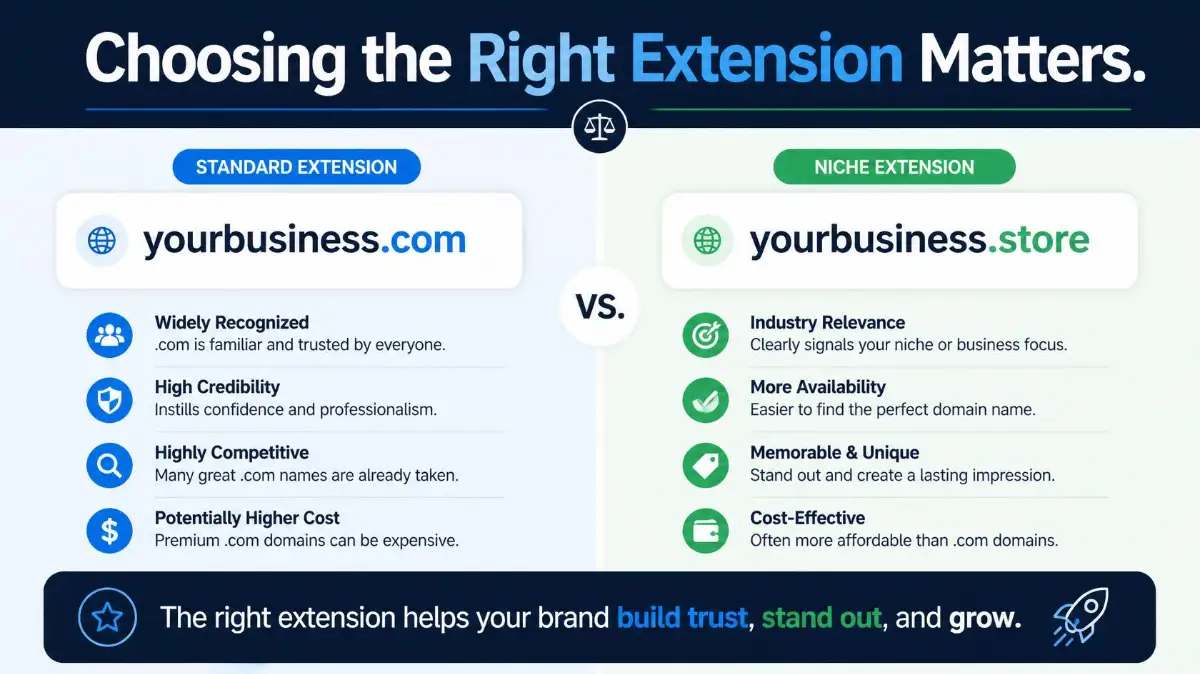
What Exactly is a Domain Name Extension?
At its simplest level, a domain name extension is the suffix at the end of your web address. You see them every day, such as .com, .org, or .net. These are formally called Top-Level Domains (TLDs). They act like the digital address for your home on the internet.
Think of your brand name as the house and the extension as the street address. You want your house to be on a reputable, easy-to-find street. If your address is hard to remember, your visitors will likely end up at someone else's front door instead.
The Power of Familiarity
The most popular extensions, like .com, have built-in trust because they have existed for decades. When users see a .com, they subconsciously assume it is a global or established business. Deviating from these standards requires you to work harder to prove your authority.
Does the Extension Affect Search Rankings?
There is a common myth that certain extensions automatically rank higher than others in search results. While search engines do not give a direct "bonus" just for being a .com, the user experience matters. If users avoid clicking your link because the extension looks suspicious, your traffic drops. Lower traffic and high bounce rates eventually hurt your overall ranking performance.
My Personal 3-Second Rule
Whenever I pick a new name, I call a friend and say the URL out loud. If they have to ask, "Wait, is that spelled with a Z or an S?" or "Did you say hyphen?", I throw the idea in the trash. If people cannot spell it in three seconds just by hearing it, you will lose traffic every single day. Keep it painfully simple.
Step-by-Step Guide to Choosing Your Digital Identity
Step 1: Prioritize Clarity and Recognition
Your primary goal should always be ease of recall. A domain that is easy to say and spell is much more likely to be remembered by your audience. Avoid using dashes or numbers that might confuse someone trying to type your address.
If your ideal name is taken, try to keep the brand name the same but choose an extension that fits your niche. For example, if you are a tech blog, a .tech extension might work well. Just ensure your audience is tech-savvy enough to recognize it. Always aim for the option that feels most natural to say out loud.
Step 2: Align with Your Brand’s Purpose
Every extension carries a slight vibe or connotation. A .org is usually associated with non-profits or community organizations. A .store or .shop clearly signals an e-commerce intent.
Match your extension to what you actually do. If you are building a personal portfolio, a .me or your own name as the domain works great. Don't pick an extension just because it is cheap. A domain is a long-term investment in your brand's image.
I once bought a domain with a hyphen just to keep a ".com" address, and it was a huge mistake. Every time I shared my link, people forgot the dash and ended up on someone else's site. My big realization was that a clean ".co" or ".me" is much better than a confusing ".com" filled with numbers or dashes.
Step 3: Check for Potential Legal and Social Clashes
Before you register, do a quick search on social media to see if others are using the same name. If someone else is using the exact same name with a different extension in your industry, avoid it. You do not want to be confused with a competitor.
Search for the name on platforms like Facebook or Instagram as well. Consistency across your website and social media channels is gold for branding. When your handle is the same everywhere, you build authority much faster.
Expert Insight: Myth vs. Reality
There is a belief that you must have a .com to succeed. While it is certainly the gold standard, it is not impossible to thrive without it. Many modern startups have gained massive success using extensions like .io or .co.
The key is brand strength. If your content is valuable and your marketing is strong, your audience will remember your domain regardless of the extension. However, if you are just starting out, a standard extension will always provide the path of least resistance.
A Quick Breakdown: Traditional vs. Modern Extensions
Still confused about which extension is right for you? Watch this simple video to see the real-world differences between traditional and modern domains, then finish the guide to learn how to keep your site safe!
Choosing between a classic extension and a modern one is a big decision. Here is how they compare so you can decide what fits your brand:
The Traditional .com Approach
- Trust Level: Remains the gold standard for global credibility.
- Availability: Often difficult to find the perfect name as many have been taken.
- Audience: Best for general, broad-based businesses that target a global consumer base.
- Best For: Established businesses, e-commerce stores, and brands that prioritize mass-market recognition.
The Modern .io or .co Approach
- Trust Level: High in tech and startup circles, but still building trust with older generations.
- Availability: Much higher chance of finding your preferred brand name.
- Audience: Targeted specifically toward tech startups, developers, and creative industries.
- Best For: SaaS products, mobile apps, innovative tech ventures, and modern personal brands that want a fresh look.
Ultimately, your domain extension is just one piece of the puzzle. It won't fix bad content, but it can definitely help people find your good content faster. Take your time, think about your long-term goals, and pick a domain that makes you proud to share it.
Step 4: Securing Your Digital Real Estate for the Long Run
Now that you have chosen a strong domain, keeping it safe is the next big move. You should treat your domain like a physical business address. If you lose access, your entire online storefront disappears overnight.

Turn on domain locking through your registrar immediately. This simple setting prevents unauthorized transfers of your domain to other providers. It acts as a digital deadbolt that keeps your assets in your hands.
Quick Tech Check: Do You Actually Own Your Name?
- Auto-Renew: Is it turned on? (If not, a bot can steal your name the day it expires).
- Domain Privacy (WHOIS): Is this active? (If not, expect a dozen spam emails a day from fake web designers).
- Registrar Lock: Is it enabled? (This stops hackers from transferring your URL to another company).
Think about whois privacy protection as well. By default, your name, email, and phone number can be public in the domain registry database. Turning on privacy hides your contact details from spammers and automated scrapers.
If you are concerned about your overall financial health or potential business risks, you can learn more about managing personal budget to ensure your business foundation stays solid. A secure domain is just the beginning of a stable business.
Step 5: Matching Your Domain with Global Standards
When you think about the biggest brands on the web, they almost always use a singular, clean domain. They do not scatter their presence across multiple, weird-looking extensions. Consistency is what builds long-term trust with your audience.
If you ever need to pivot or add new services, stick to your primary domain. Don't go out and buy five different extensions for the same site. It confuses search engines and spreads your link authority too thin.
Focus on building your brand’s reputation on one solid foundation. You can read this guide on mastering your health policy to understand how to manage business limits and deductibles, which is similar to managing your digital resources. Always aim for simplicity.
Pro-Level Secret: The Redirect Strategy
If you absolutely must grab a secondary domain to prevent others from taking it, use a 301 redirect. This points the extra domain directly to your main site. It keeps your traffic concentrated in one spot.
Never let multiple domains serve the same content simultaneously. This creates a "duplicate content" issue that confuses search engines like Google. You can find more technical advice on domain management strategies from reputable financial and technical sources.
Always keep your setup clean. A tidy digital footprint is easier to manage and grows in value much faster than a cluttered one.

Your Path to a Stronger Online Presence
You now have the knowledge to pick a domain that represents your brand with authority. It is not just about the text inside the browser bar; it is about the trust you build with every single visitor.
Do not let the fear of making a wrong choice hold you back. The most important step is to start building something meaningful today. A great domain provides the stage, but your content is what truly performs.
Your Action Plan for Tomorrow
- Search: Check the availability of your top three name choices.
- Verify: Look at the social media handles to match your domain.
- Secure: Register the domain and enable auto-renew immediately.
- Protect: Turn on privacy settings to keep your data off public lists.
You are fully equipped to take the next step. Your online journey starts with a single, smart choice. Go ahead and register that domain with confidence. Your future audience is waiting to find you.
Don't let the search for the "perfect" name hold you back from your dreams. I have seen so many people wait months for a name while others started with a simple one and became successful. Pick a name that feels solid, take that first step, and start sharing your work with the world right now!
Disclaimer: This blog post provides general educational information regarding domain selection and branding. It does not constitute legal or professional business advice. Always conduct your own due diligence before registering domain names or making significant business investments. We are not responsible for any domain-related losses or legal issues arising from the use of this information.
THANK YOU