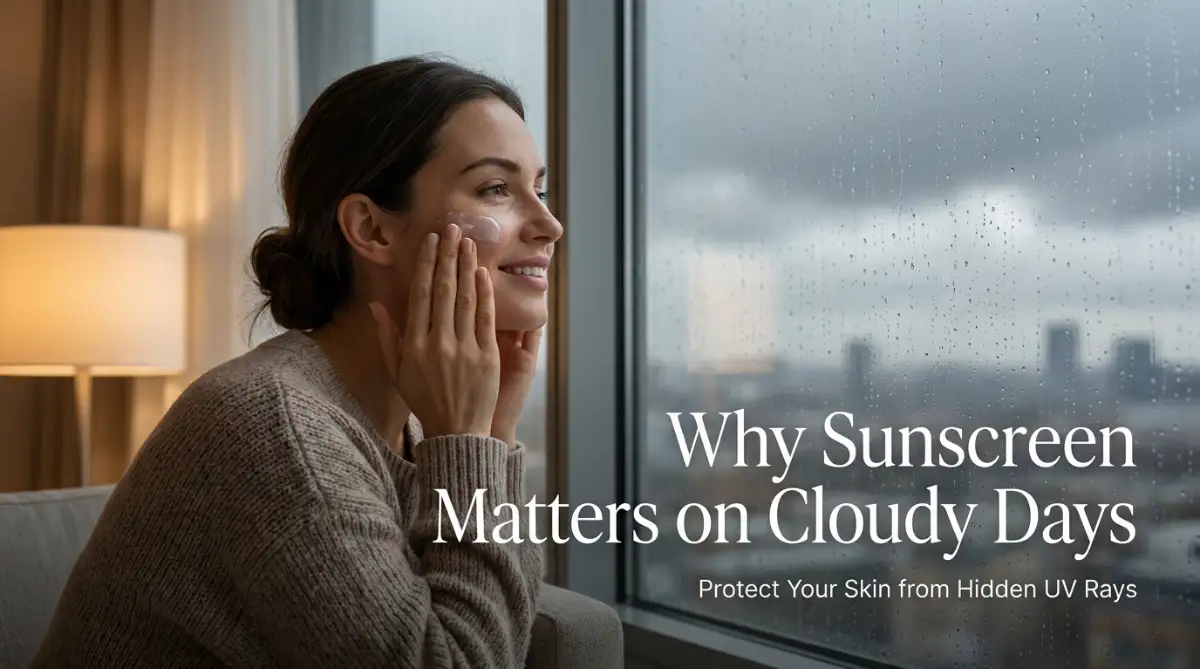
My Unexpected Battle with Skin Damage When the Sun Was Hiding
You look out the window, see thick rain clouds, and think your skin is perfectly safe today. I used to think the exact same thing. I would gladly skip my sticky morning sunscreen, assuming it was a smart way to save five minutes. But when dark spots started showing up on my cheeks out of nowhere, my dermatologist gave me a huge reality check. Those gloomy gray clouds were actually destroying my skin.
But a few months later, I noticed stubborn dark spots forming on my cheeks and fine lines appearing out of nowhere. I panicked and immediately booked an appointment with my local dermatologist to figure out what was going wrong. She took one close look at my face and simply asked if I was skipping my sun protection during gloomy weather. That is when I realized my biggest skincare mistake, and it completely changed how I treat my face every single morning.
So many of us fall into this exact same trap without even realizing it. We wake up, look out the window, and see nothing but thick, gloomy clouds covering the entire neighborhood. The weather feels cool, the sky looks dark, and our brain automatically tells us that we do not need to worry about sun damage today.
Without a second thought, we leave our expensive SPF bottles sitting untouched on the bathroom counter. We go about our day, walking to the bus stop, driving to work, or simply sitting near a large glass window. We feel completely safe under the illusion that the clouds are acting as a giant, protective umbrella for our skin.
But this innocent, everyday mistake slowly steals our youthful glow and quietly damages our delicate skin barrier. You might not feel the burning sensation of a hot summer day, but the invisible damage is happening deep beneath the surface of your skin. Over time, this leads to early signs of aging, unexpected hyperpigmentation, and a severe loss of skin elasticity.
Your Cloudy Day Survival Checklist
- UVB rays (burning) are blocked by clouds, but UVA rays (aging) pass right through them.
- Glass windows do not stop aging rays—you need protection even if you sit in an office all day.
- Use the "two-finger rule" for sunscreen, no matter how dark or stormy the sky looks.
- Always double cleanse at night to get that stubborn, water-resistant SPF off your face completely.
The Science Behind Invisible Damage: How Clouds Masterfully Deceive Us
To truly understand why your skin suffers on a gloomy day, we need to look at exactly how sunlight behaves. The sun produces different types of energy, and the ones we care about the most are Ultraviolet A (UVA) and Ultraviolet B (UVB) rays. When you step outside on a bright summer afternoon and feel your skin burning, you are feeling the immediate effects of UVB rays.
These UVB rays are the ones responsible for turning your skin red and causing painful sunburns. Fortunately, thick rain clouds can actually block a significant portion of these burning UVB rays. This simple fact is exactly why you rarely get a visible sunburn when the weather is heavily overcast.
However, the real hidden danger lies entirely with UVA rays. These specific rays are known as the "aging rays" because they penetrate much deeper into your skin layers. Unlike UVB rays, UVA rays are incredibly powerful and completely ignore weather conditions.
Thick gray clouds, heavy rain, and even dense fog do absolutely nothing to stop UVA rays from reaching your face. Up to 80 percent of these dangerous aging rays easily push through the thickest clouds and hit your skin directly. Because you do not feel any heat or burning sensation, your brain assumes you are totally safe while your skin is actively taking silent damage.
The Sneaky Cloud UV Scale
- Solid Rain Clouds: Blocks about 70% of burning rays, but blocks nearly 0% of aging rays.
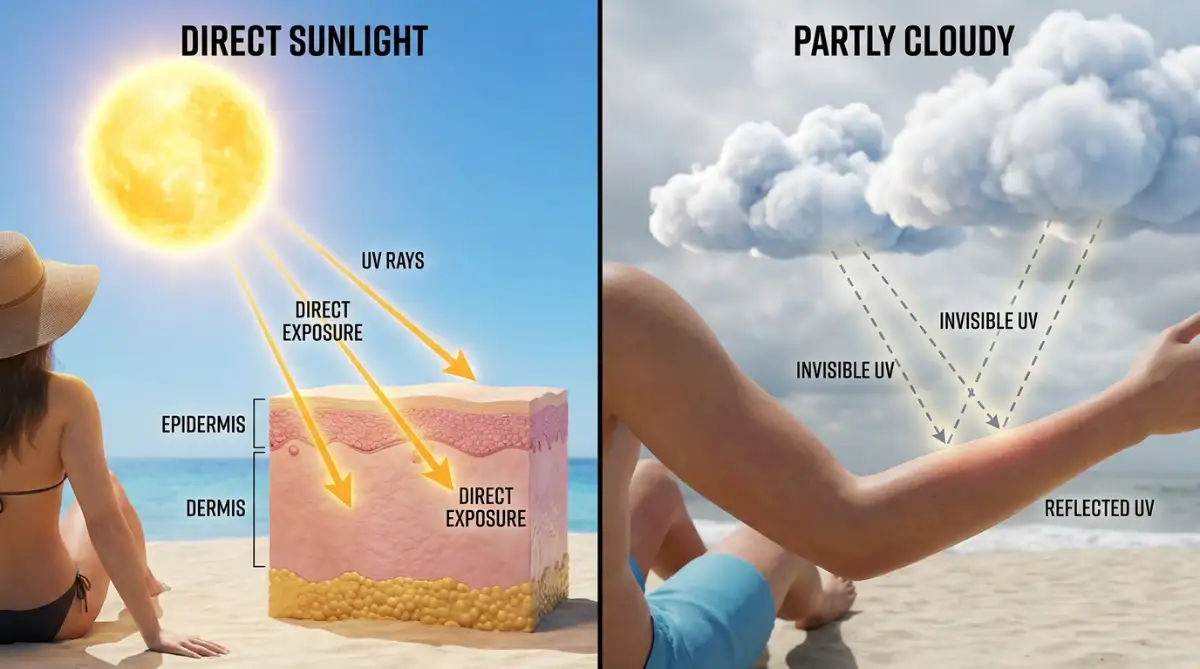
- Partly Cloudy/Scattered: The absolute worst kind! Fluffy clouds act like giant mirrors, bouncing UV rays directly at your face and actually increasing your exposure by up to 25%.
- Thick Fog: It feels super cooling, but fog simply traps UV rays close to the ground. This means your skin absorbs radiation all morning long.
Understanding the Two Types of UV Rays
To make things incredibly clear, let us look at a simple breakdown of how these different invisible rays affect your daily life. Knowing this difference is the secret to finally protecting your skin properly.
The Strange Phenomenon of Cloud Enhancement
There is another fascinating scientific reason why you must protect your skin during bad weather. Sometimes, partial cloud cover can actually make the sun's rays much more dangerous than a completely clear blue sky. This happens due to a strange scientific event known as the "cloud enhancement effect."
When the sun peeks out from behind the edges of fluffy white clouds, the water droplets inside those clouds act like millions of tiny mirrors. They catch the invisible UV rays and reflect them directly down toward the ground, magnifying their strength. This means you might actually be getting hit with a higher dose of radiation on a partly cloudy day than on a completely cloudless afternoon.
Breaking Down the Biggest Everyday Skincare Illusions
One of the biggest reasons people skip their sun protection is because they rely on their own physical senses to judge the danger. If we feel hot, we apply lotion. If we feel cold, we assume we are perfectly safe.
This is a massive psychological barrier that we have to break through if we want clear, healthy skin. Your skin does not care about the local temperature or whether you need to wear a heavy winter coat outside. Radiation does not have a temperature, and UV damage can happen even if it is freezing cold outside.
I remember buying the most expensive vitamin C serum on the market, hoping to fade my dark patches once and for all. But because I kept skipping my SPF on rainy days, I was basically flushing my hard-earned money right down the drain. My biggest pro tip for you is to stop treating sun protection as a seasonal weather accessory. Always apply your sun protection as the absolute final step of your morning routine, even if you are just sitting by a large living room window listening to the rain outside.
If you are still wondering exactly how those invisible UV rays penetrate thick rain clouds and reach your skin, this short visual breakdown explains the science perfectly.
Practical Steps to Build a Weather-Proof Daily Routine
Now that we understand exactly how clouds deceive us, it is time to take immediate action. You do not need to overcomplicate your mornings to keep your skin entirely safe from invisible damage. You just need to build a few simple, rock-solid habits that you can rely on every single day.
The first step is shifting your mindset away from checking the weather forecast before doing your skincare. You should treat your daily SPF exactly like you treat brushing your teeth. You do not skip brushing your teeth just because it is raining outside, and you should never skip protecting your face either.
Finding the Right Formula for Gloomy Days
A major reason people hate applying SPF on dark days is the heavy, greasy feeling it leaves on their face. When it is humid and rainy outside, the last thing you want is a thick, white, chalky cream melting into your pores. The secret is to keep a dedicated, lightweight formula specifically for these types of days.
Look for modern chemical sunscreens or ultra-lightweight mineral fluids that absorb into the skin like a simple glass of water. Asian beauty markets, particularly Korean and Japanese brands, excel at creating water-based gels that feel completely invisible once applied. When your product feels like a luxurious daily moisturizer rather than a heavy beach paste, you will actually look forward to putting it on.
The Two-Finger Rule Remains Non-Negotiable
Another massive mistake people make on overcast days is applying way too little product. Because the sun is hiding, they take a tiny, pea-sized drop of lotion and quickly rub it over their cheeks. Unfortunately, applying a tiny amount gives you a drastically lower level of protection than the bottle promises.
If you apply half the required amount of an SPF 50 product, you are not getting SPF 25. You are likely getting the protective equivalent of an SPF 5 or 10, which is practically useless against strong UVA rays. Always use the standard two-finger rule, measuring two full lines of product across your index and middle fingers, to ensure your entire face and neck are properly covered.
Navigating Indoor Dangers and Large Windows
You might be reading this and thinking that you are perfectly safe because you work inside a cozy office all day. But remember our earlier discussion about how UVA rays behave around glass. Standard home and car windows are excellent at blocking UVB rays, which is why you never get a sunburn while driving.
However, those exact same windows do absolutely nothing to stop the aging UVA rays from passing straight through the glass. If your office desk is sitting right next to a beautiful large window, the gloomy daylight pouring in is actively breaking down your skin's collagen. Even if you never step foot outside in the rain, that indoor window exposure adds up significantly over the years.
To combat this, make sure your morning routine includes full coverage before you even sit down at your desk. If you have a long commute in your car, your hands and the side of your face closest to the window are taking a massive hit from invisible radiation. Keep a small stick applicator in your car so you can easily swipe it over your hands and cheeks before grabbing the steering wheel.
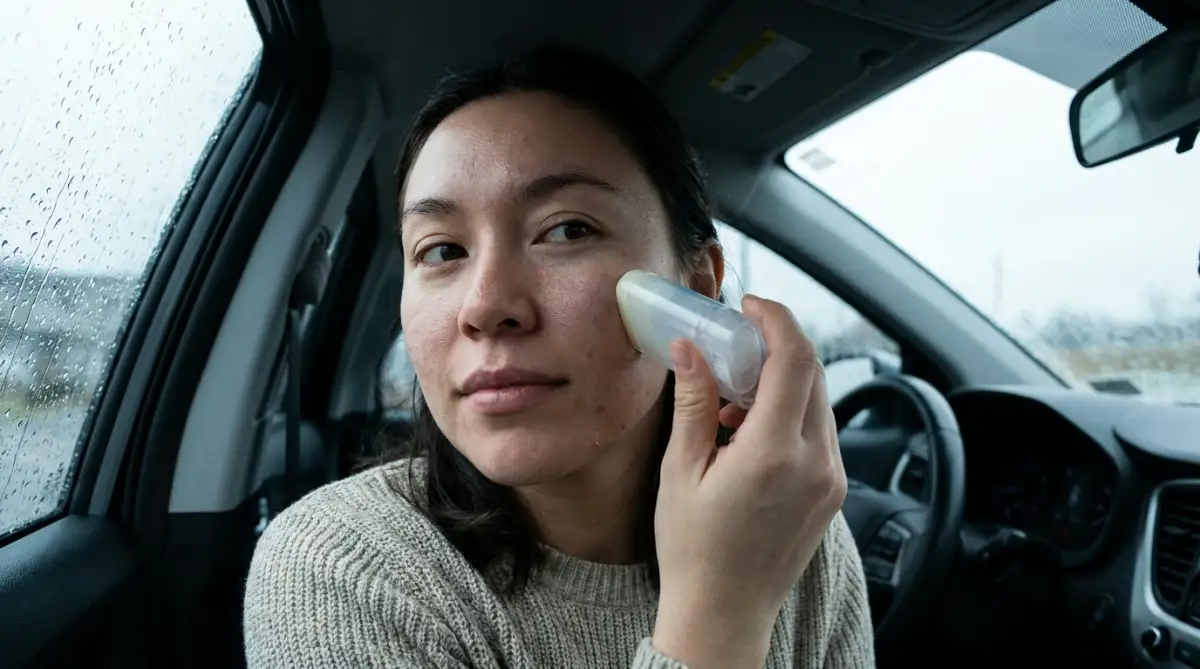
Reapplication Strategies When You Do Not Feel the Heat
We all know we are supposed to reapply our protection every two hours, but let us be entirely honest with ourselves. Nobody wants to rub a messy liquid lotion all over their face in the middle of a dark, cold, rainy afternoon. It feels unnatural and incredibly inconvenient, especially if you are wearing makeup.
This is exactly where modern skincare technology becomes your absolute best friend. Instead of using traditional lotions for reapplication, invest in a high-quality SPF setting spray or a translucent mineral powder. A quick spray over your face takes less than five seconds and provides the perfect boost of protection against those sneaky UVA rays pushing through the afternoon clouds.
My 3-Second Reapplication Trick
I personally hate messing up my makeup. So, I keep a transparent mineral SPF powder in my purse at all times. When 2 PM rolls around, I just dust it quickly over my forehead and nose. It acts exactly like a normal setting powder, takes away that oily afternoon shine, and gives me full UVA defense without melting my foundation.
By making these tiny adjustments to your daily life, you are securing the long-term health and beauty of your face. You will stop wasting money on dark spot correctors and finally start seeing the glowing results you deserve. Taking control of your environment means realizing that the sky above you is always active, and your protection should always be active too.
Next-Level Strategies for Unbeatable Daily Protection
Building a solid morning habit is a great start, but keeping your skin perfectly healthy for years requires a bit more knowledge. The biggest secret among top dermatologists is not just wearing SPF, but knowing exactly how to supercharge its protective power. When you combine the right ingredients, you create an invisible shield that totally locks out environmental damage.
One of the smartest things you can do is pair your morning sun protection with a powerful antioxidant serum. Think of your sunscreen as a heavy wooden door blocking the UV rays from entering your home. An antioxidant like vitamin C acts as an extra security system, catching any sneaky rays that manage to slip past the door.
When you apply a high-quality vitamin C serum before your SPF, you instantly double your skin's defensive power. The American Academy of Dermatology actually notes that antioxidants help neutralize harmful free radicals generated by sneaky UV exposure. This means even if a few aging rays penetrate the thick rain clouds outside, your skin is already armed and ready to fight them off.
Decoding the PA Rating System
Most people only look at the large SPF number on the front of the bottle, but that number only tells half the story. The SPF number strictly measures how well the product blocks UVB rays, which are the ones that cause sunburns. As we discussed earlier, we are much more worried about the UVA rays that pass straight through dark storm clouds.
To make sure you are blocking those deep-penetrating aging rays, you must look for the "PA" rating on your bottle. This system uses plus signs to show exactly how much UVA protection the formula offers your skin. A rating of PA+ gives you very basic protection, while PA++++ offers the highest possible defense against invisible skin aging.
If you live in an area with constant overcast weather, a PA++++ rating is absolutely non-negotiable for your daily routine. According to guidelines from the Skin Cancer Foundation, checking for a strong broad-spectrum label or a high PA rating is the only way to guarantee you are fighting off wrinkles. Next time you go shopping, flip the bottle over and make sure those little plus signs are printed right there on the label.
Matching the Formula to Your Base Canvas
Another major secret to consistent sun protection is finding a product that completely matches your unique face. If you have extremely oily skin, applying a heavy moisturizing SPF will make you feel like a greasy mess. If you have dry patches, a matte mineral formula will cling to those spots and look absolutely terrible under your makeup.
You will only stick to your routine if your product feels completely weightless and comfortable all day long. To get this right, you first need to figure out your exact skin type before buying random expensive bottles online. Once you know if your face prefers hydration or oil control, shopping for the perfect daily fluid becomes incredibly easy.
If you are trying to keep your mornings completely stress-free, look into a minimalist skinca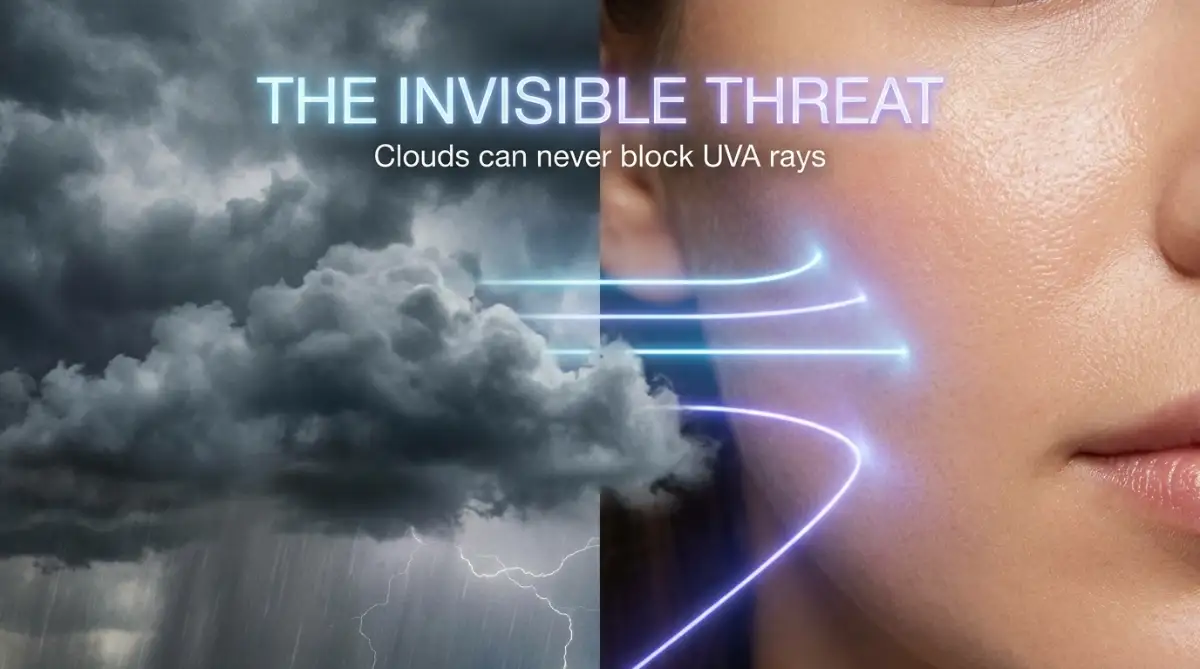 re approach that uses hybrid products. Many modern SPFs now include hydrating ingredients like hyaluronic acid and soothing ceramides built right into the formula. This allows you to skip your regular daily moisturizer completely and use your sun protection as a two-in-one step.
The Dangerous Skincare Traps Most People Fall Into
Even when people have the best intentions, they often make innocent mistakes that completely ruin their daily sun protection. These little errors might seem totally harmless at first glance, but over the years, they lead to massive frustration. Let us talk about the most common traps you need to avoid if you want to keep your face looking bright and youthful.
The absolute biggest trap I see people fall into is relying entirely on their daily makeup for sun protection. So many foundation bottles proudly advertise "SPF 15" or "SPF 20" on the front label, making buyers feel instantly safe. Because the bottle says SPF, people naturally assume they can skip their dedicated sun lotion entirely.
But this creates a horrible false sense of security that leaves your skin incredibly vulnerable to invisible cloudy day radiation. To get the actual SPF number advertised on a foundation bottle, you would have to apply a massive, thick layer of makeup to your face. You would end up looking like you are wearing a heavy theatrical mask, which absolutely nobody does in real life.
Because we only use a few tiny drops of foundation to even out our skin tone, we get almost zero real protection. You end up walking outside into the gray weather thinking you are fully shielded, while UVA rays are happily damaging your skin cells. Always use a dedicated, standalone protection layer first, and then apply your favorite makeup directly over the top of it.
The Tragedy of the Forgotten Neck and Chest
Another heartbreaking mistake is treating the jawline as an invisible boundary where skincare magically stops. People will carefully apply their expensive lotions all over their cheeks and forehead, completely ignoring their poor neck and chest. This creates a really strange situation where a person's face looks wonderfully youthful, but their neck shows heavy signs of deep sun damage.
The skin on your neck and upper chest is actually much thinner and significantly more delicate than the skin on your face. This means these areas break down much faster when exposed to the sneaky UV rays bouncing around on an overcast afternoon. Medical experts at the Cleveland Clinic frequently warn that the neck and hands are the most common places to spot severe early aging.
Make it an unbreakable rule to drag your daily SPF all the way down to your collarbone every single morning. If you are wearing a v-neck shirt or a light sweater, that exposed skin needs exactly the same amount of love as your cheeks. You will thank yourself immensely ten years from now when your skin tone looks perfectly even from your forehead down to your chest.
The Evening Cleansing Disaster
Here is a major pitfall that catches so many people completely off guard: not properly washing off their sun protection at the end of the day. Modern SPFs are specifically designed to be incredibly tough, water-resistant, and highly adherent to your skin. They are formulated to cling to your face tightly so they do not melt off when you sweat or walk through high humidity.
Because they are built to be so stubborn, a simple splash of water and a gentle morning cleanser will not remove them completely. If you leave invisible traces of SPF trapped inside your pores overnight, you will quickly develop painful breakouts and dull texture. People often blame their new lotion for causing acne, when the real problem is just poor evening face washing habits.
To avoid this horrible trap, you must start practicing the double cleansing method every single night. Start with a gentle oil-based cleanser or a melting cleansing balm to completely break down the tough, water-resistant SPF layer. Follow up immediately with your regular water-based foaming cleanser to wash all those dissolved impurities straight down the drain.
Your New Action Plan for Healthier, Glowing Skin
We have covered a lot of deep scientific ground today, but the main takeaway is surprisingly simple and easy to manage. Thick gray clouds, heavy rainstorms, and dark gloomy weather are basically massive optical illusions designed to trick your brain. The dangerous aging rays are always present, always active, and always looking for a way to break down your beautiful skin.
You no longer have to feel confused about why your expensive dark spot correctors are totally failing to deliver results. By simply wearing your protection every single day, you are literally hitting the pause button on premature aging. You are giving your skin a safe, protective bubble where it can naturally heal itself without constantly fighting off new invisible damage.
Take a quick moment today to check your exact skin profile at home so you know what kind of formula will feel best on your face. Once you find that perfect, weightless product, put it right next to your toothbrush so you never forget to use it. Make it such a natural part of your morning that you automatically apply it before you even check the weather forecast.
Everyday Questions People Always Ask
Will overcast days make my current dark spots worse?
Yes, they absolutely will if you step outside completely unprotected. The UVA rays that easily push through thick clouds directly trigger your skin to produce more melanin, which immediately darkens your existing hyperpigmentation.
Does wearing SPF prevent me from getting a tan on cloudy days?
Yes, a high-quality broad-spectrum formula will largely prevent your skin from tanning. Tanning is actually your skin's desperate trauma response to UV damage, so preventing a tan means you are successfully protecting your healthy cells.
Do I really need protection if I just stay inside my house all day?
If your house has large open windows that let in natural gloomy daylight, you definitely need protection. Standard glass windows block burning rays but allow aging UVA rays to pass right through and hit your skin while you relax on the couch.
How do I reapply my protection over a full face of makeup?
You never want to rub a liquid lotion over carefully applied foundation or concealer. Instead, use a completely translucent SPF setting spray or a fine mineral powder brush to quickly touch up your protection without ruining your makeup.
Does the blue light from my phone and computer cause skin damage?
Recent dermatological studies show that prolonged exposure to heavy blue light from digital screens can contribute to mild hyperpigmentation and skin stress. Using a tinted mineral sunscreen with iron oxides offers excellent indoor protection against both blue light and cloudy window light.
Disclaimer: The information provided in this article is for educational and informational purposes only and does not constitute professional medical advice. Always consult with a board-certified dermatologist or healthcare provider before starting any new skincare routine, especially if you have a history of sensitive skin conditions, allergies, or serious skin health concerns. For more trusted skincare insights, always verify new ingredients with your personal doctor.
THANK YOU