
When the Safety Net Breaks: My Shocking Wake-Up Call
Let us be completely honest—getting a rejected medical bill in the mail feels like a sudden punch to the gut. You pay your premiums on time every single month, so why are you suddenly staring at a massive bill you cannot afford? I have been in that exact spot, tearing my hair out over confusing paperwork and losing sleep. But here is the good news: insurance companies make mistakes constantly, and you can absolutely fight back and win.
Medical debt is a silent storm that ruins the daily peace of millions of hardworking people. You wake up every morning with a knot in your chest, wondering how you will ever pay off thousands of dollars in surprise bills. It changes how you live, making you scared to even visit a doctor for a simple check-up. The constant worry affects your focus at work and ruins precious moments with your family. You start cutting back on groceries, skipping family outings, and constantly checking your bank balance in pure fear.
But here is the absolute truth I learned the hard way: a rejection letter is not the end of the road. Insurance companies make mistakes all the time, and their initial "no" is often just a test to see if you will give up. Once you understand their hidden rules, you can fight back and win. I decided to take control, learn the system, and reverse my situation completely.
Now, I want to show you exactly how to do the same thing. You do not have to accept unfair financial ruin just because a computer generated a rejection letter. Let us break down the exact reasons these rejections happen and how you can protect your hard-earned money today.
Your Quick Action Plan (Do Not Skip This!)
- Never pay right away: Paying kills your leverage. Always ask the hospital to freeze your account while you dispute the charge.
- Get the itemized list: Hospitals hide crazy markups in summary bills. Demand the line-by-line breakdown to spot fake charges.
- Find the hidden code: Your EOB document has a tiny denial code at the bottom. That little code is the whole secret to winning your appeal.
- Use the "Peer-to-Peer" trick: Force the insurance company's doctor to argue on the phone directly with your personal doctor.
Decoding the Rejection: The Hidden Traps in Your Policy
The first step to fighting a rejected medical bill is understanding exactly why it happened in the first place. You cannot win a game if you do not know the rules the other side is playing by. Let us look at the most common traps that catch honest people off guard.
The Illusion of "In-Network" Doctors
One of the biggest shocks you can get is finding out your trusted doctor is actually out of your network. You might visit a hospital that accepts your coverage, but the specific specialist who treats you might not. This happens all the time with emergency room doctors, anesthesiologists, and outside lab technicians.
Imagine you are eating at a restaurant where you have a huge discount card. You order your food, but then find out the chef who cooked it requires a totally separate payment. That is exactly how out-of-network billing works in the medical world. Your primary care facility might be approved, but the individuals working inside it operate as independent contractors.
Myth vs. Reality Checklist:
- The Myth: If the hospital building has my provider's logo on the door, every doctor inside accepts my card.
- The Reality: The building is just a building. Doctors inside often bill you as independent contractors who do not care about your network rules.
- The Myth: If I go to the emergency room, network rules fly out the window.
- The Reality: New laws do protect you from some surprise emergency bills, but insurance companies will still fight you. You usually have to prove you were in true, immediate danger.
Always ask every single person who walks into your hospital room if they are directly contracted with your specific coverage plan. It feels awkward to ask, but it can save you thousands of dollars. Take notes of their names and what they tell you, just in case you need to argue your case later.

Skipping the Permission Slip (Prior Authorization)
Many people assume that if their doctor says they need a treatment, the insurance company will automatically agree. This is a massive mistake that causes countless rejections every single day. For expensive procedures, surgeries, or high-tier medications, your provider must ask the company for permission first.
This process is called prior authorization, and it is basically a permission slip for your healthcare. If you skip this step, the company will almost always deny the bill, even if the treatment saved your life. They want to verify that the treatment is medically necessary before they agree to open their wallets.
Here is my personal advice on handling this confusing step. I learned this the hard way when I tried to rush a physical therapy schedule without double-checking the paperwork first.
My Pro Tip: I always call my provider's billing office one week before any major appointment to confirm they actually received the approval code. If they tell me it is still pending, I immediately reschedule the appointment rather than risking a massive surprise bill. Taking this small step has completely changed my confidence when walking into a clinic.
Always keep a personal record of these approval codes. Write them down in a notebook along with the date, the time, and the name of the representative you spoke to. This little notebook will become your best friend if the company tries to claim they never approved your treatment.
The Nightmare of Medical Coding Typos
You would be amazed at how many massive medical bills are rejected simply because someone hit the wrong button on a keyboard. Medical billing relies on a very complex system of numbers and letters called CPT codes. Every single bandage, blood test, and minute of a doctor's time has a specific code attached to it.
If the person typing up your chart accidentally swaps a number, the computer system will automatically reject the payment. For example, a code for a routine check-up might accidentally get typed as a complex surgical procedure. The insurance computer sees a mismatch with your medical history and spits out a denial instantly.
Watch This Expert Breakdown
Understanding how to spot these sneaky typos can literally save you thousands of dollars in unfair bills. Check out this incredible breakdown of how simple coding errors happen and what you can do to spot them on your next bill.
Press play to see a real-life example of how a simple wrong number on a keyboard can automatically trigger a massive, unfair bill. Spotting this one typo is a total game changer.
You have the legal right to request an itemized bill from your hospital or clinic. This document breaks down every single charge line by line, rather than just giving you one massive total to pay. When you look closely, you might find charges for medications you never took or tests that never happened.
Call the billing department immediately if you spot something weird on your itemized list. Be polite but firm, and ask them to verify the codes with your actual patient chart. Most hospitals are willing to fix simple typos because they want to get paid by the insurance company just as much as you want them to.
Sneaky Billing Typos You Need to Check For Today
The Fine Print Sickness: What They Refuse to Pay For
Sometimes, the rejection has nothing to do with typos or networks. It happens because the specific treatment you received is simply not part of your contract. Every policy has a strict list of exclusions, which are services they absolutely refuse to cover under any circumstances.
Understanding Medically Necessary vs. Experimental
Insurance companies love to use the phrase "not medically necessary" to reject expensive bills. This means they think you could have used a cheaper treatment, or they believe the procedure was just for cosmetic reasons. They base these decisions on strict clinical guidelines that might not match what your doctor thinks is best for you.
Another common excuse is labeling a new treatment as "experimental." If your doctor uses a cutting-edge therapy that is not widely accepted yet, the company will block the payment. They want years of proven data before they agree to spend money on newer medical advancements.
If you get a rejection based on medical necessity, your doctor is your best weapon. They can write a detailed letter of medical necessity explaining exactly why this specific treatment was your only viable option. When a trained medical professional challenges a desk worker at a corporation, the professional often wins.
The Clock is Ticking: Missing Submission Deadlines
Time is literally money when it comes to healthcare paperwork. Every policy has a strict window of time during which a claim must be submitted. This window is usually between 90 days and one year from the date you received the medical service.
If your doctor's office is disorganized and submits the paperwork even one day late, it will be automatically denied. The worst part is that you might end up holding the bag for their administrative laziness. The insurance company will say the deadline passed, and the hospital will try to pass the bill directly to you.
Do not ever assume the clinic is handling your paperwork efficiently. You need to actively track the progress of your paperwork through your online patient portal. If a month goes by and you do not see any activity on your account, pick up the phone and start asking questions.
A Quick Warning From My Own Inbox:
I once watched a close friend miss out on a $2,000 payout simply because her doctor submitted the final form two days past the 90-day window. Two days! The insurance company pointed to their rulebook and flat-out refused to pay. My friend had to set up a payment plan with the hospital out of her own pocket. Do not let someone else's lazy paperwork habit drain your bank account.
Keep a calendar dedicated purely to your medical appointments and paperwork timelines. Set reminders on your phone to check the status of your accounts every single week. Staying organized is your best defense against an industry that profits off your confusion.
How to Read Your Explanation of Benefits (EOB) Like a Pro
The key to unlocking your billing mysteries lies in a document called the Explanation of Benefits. You probably get these in the mail and throw them away because they look like complicated math tests. But the EOB is actually a cheat sheet that tells you exactly where your money is going.
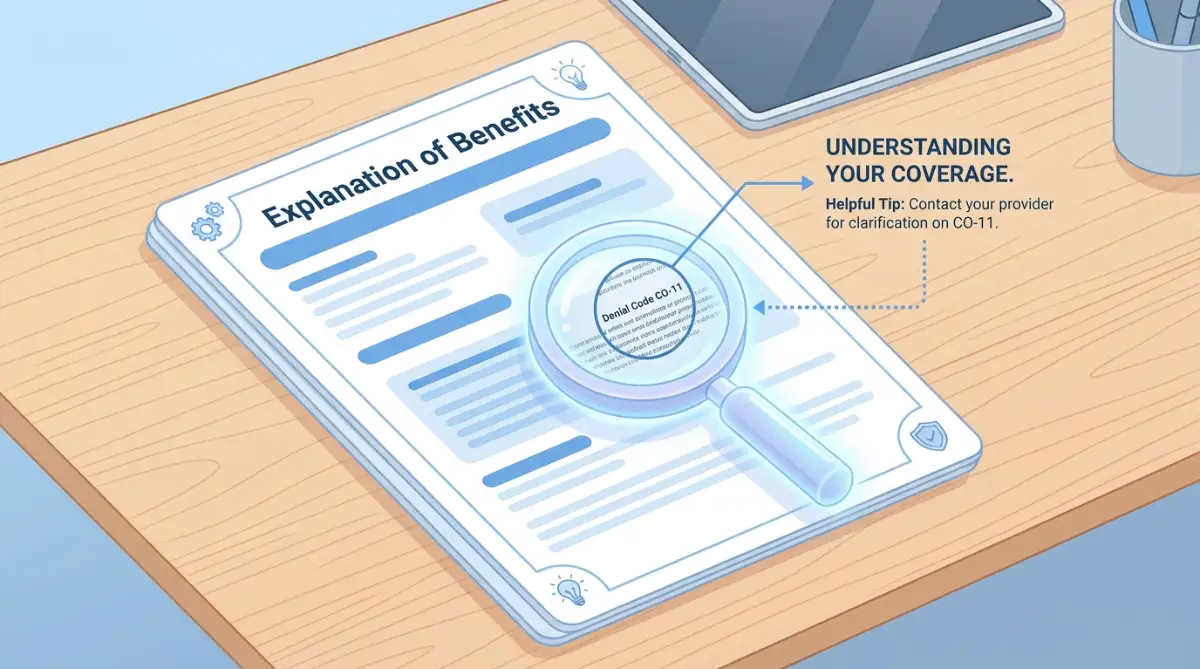
The EOB is not a bill, even though it often looks like one. It is a communication from your coverage provider explaining what they paid, what they rejected, and what your final responsibility might be. You will see columns showing the amount billed, the allowed amount, and the dreaded denial codes.
Those little denial codes are the secret to winning your appeal. They are usually small letters or numbers at the bottom of the page, like "CO-11" or "PR-1". These codes tell you exactly why they refused to pay, whether it was a missing signature, a wrong date, or an out-of-network charge.
Once you find the code, search for its meaning on the internet or call the customer service number on the back of your card. Do not let the representative rush you off the phone; make them explain the code in plain, simple English. Understanding this single document puts you in the driver's seat of your financial health.
Building Your Bulletproof Appeal File
Now that you know exactly why the rejection happened, it is time to fight back. You have the legal right to appeal any denial, asking the company to look at the paperwork a second time. A massive percentage of appeals are successful, simply because most people never bother to try.
Start by gathering every single piece of paper related to your visit. You need the itemized bill, your EOB, notes from your doctor, and any emails or messages from the clinic. Print everything out and organize it neatly in a physical folder so you do not lose track of the details.
Write a clear, unemotional letter stating exactly why you disagree with their decision. Do not use angry language, no matter how frustrated you are, because you want the reviewer to take you seriously. Stick to the facts, reference their own policy rules, and attach all your supporting evidence.
My Go-To Appeal Template Trick:
Do not overthink your letter. Keep it stupidly simple. I always use this exact format to get their attention fast:
- The Facts: "On [Date], I received [Treatment], which my doctor deemed medically necessary for [Condition]."
- The Error: "Your denial code [Code] states this was out-of-network, but the facility was in-network and I had no choice over the attending specialist."
- The Demand: "I am requesting a full reprocessing of this claim immediately."
Send this appeal package through certified mail so you have proof they actually received it. This forces them to acknowledge your dispute and starts a legal timeline for them to respond. When you present a highly organized, factual argument, you show them you are not an easy target.
Taking the Upper Hand: Insider Secrets the Billing Department Hides
Most people think that once they send an appeal letter, all they can do is cross their fingers and wait. But you actually have several hidden weapons at your disposal to force a fair decision. The insurance companies do not want you to know about these advanced strategies because they are incredibly effective. When you start using their own internal rules against them, you suddenly become a priority instead of a number.
One of the most powerful tools you can use is asking for a "Peer-to-Peer Review". If your claim was denied for a lack of medical necessity, a desk clerk is usually the one who made that call. You can legally request that the insurance company's medical director speaks directly on the phone with your actual doctor. This forces a real physician to justify why they are denying a treatment that your personal doctor strongly recommends.
In most cases, the corporate doctor does not want to argue clinical facts with a specialist over the phone. They often fold and approve the treatment simply because your doctor presented undeniable medical facts. You can learn more about setting up this exact process by checking out the complete roadmap to getting your medical claims approved. It is a completely free strategy that moves mountains in the medical billing world.
Another massive secret is bringing in outside authority when the company refuses to listen to reason. Every single state has a government office dedicated entirely to regulating these massive corporations. If you feel you are being treated unfairly, you can easily file an official complaint with your state insurance department. As soon as a government regulator contacts the company on your behalf, their attitude changes instantly.
These regulatory offices have the power to audit the company, issue massive fines, and force them to pay your bill. The billing departments are terrified of state audits because it costs them a huge amount of time and money. Just mentioning in your appeal letter that you plan to contact the state commissioner often triggers a sudden "re-evaluation" of your case. You do not need to be a lawyer to do this; you just need to know who holds the power.
Let us also talk about a hidden metric called the Usual, Customary, and Reasonable (UCR) charge. Sometimes, your claim is partially denied because the company claims your doctor charged way too much for a basic service. They will only pay a tiny fraction of the bill, leaving you to cover the massive remaining balance. This sneaky tactic is called balance billing, and it destroys household budgets every single day.
You do not have to accept their random math regarding what a service should cost. You can look up fair healthcare prices in your specific zip code using independent online pricing tools. If you prove that your doctor's rate is actually normal for your city, the company is forced to adjust their payout. Having hard data completely ruins their argument and puts the financial responsibility back on them.

The Silent Financial Killers: Why Most People Lose Their Appeals
Fighting a massive healthcare corporation is a delicate process, and one wrong move can destroy your chances of winning. People usually panic when they see a huge balance due, and that panic leads to terrible financial decisions. If you let fear guide your actions, you will end up paying for mistakes that were never your fault. We need to talk about the dangerous traps that catch honest families off guard.
The single biggest mistake you can make is panic-paying the bill just to make it go away. When people get threatened with debt collectors, they often drain their savings or use high-interest credit cards to pay the hospital instantly. They assume they can just fight the insurance company later and get a refund once the dust settles. I am telling you right now, getting a refund from a medical facility after you already paid them is almost impossible.
Once the hospital has your money, their motivation to help you fix the coding errors drops to absolute zero. You lose all your leverage the second you swipe your debit card or hand over a personal check. Instead of paying, you need to understand how to stop wasting money and avoid these family health insurance mistakes. Tell the billing department that the charge is under an active dispute and ask them to freeze the account.
Another terrible mistake is ignoring the envelopes because they cause you too much anxiety. We call this the ostrich effect, where you just bury your head in the sand and hope the problem magically disappears. Medical bills never disappear; they only grow larger through aggressive late fees and aggressive collection tactics. If you ignore the mail, you will easily miss the strict deadlines required to file your legal appeal.
Finally, please never lose your temper with the customer service representatives on the phone. I completely understand how frustrating it is to be put on hold for an hour just to be told your bill is denied. But the person answering the phone is just a regular human reading a script on a computer screen. They did not personally deny your coverage, and yelling at them will guarantee they do the bare minimum to help you.
If you are kind, patient, and treat them with respect, they will often go out of their way to find a solution. A friendly representative might secretly tell you exactly which medical code you need your doctor to change to get approved. They have access to the hidden rules, so you want them on your team, not working against you.
Reclaiming Your Peace of Mind and Bank Account
You no longer have to feel completely powerless when that terrifying rejection letter arrives in your mailbox. The entire medical billing system is built on the assumption that you will just give up and pay out of pocket. By simply choosing to push back and ask questions, you are already miles ahead of the average patient. You have the right to demand clear answers, fair treatment, and the financial coverage you pay for every month.
Building a solid safety net of knowledge is the best way to protect your family from future medical debt. Before you ever schedule another surgery or expensive test, make sure you know your policy inside and out. You can start by reading how comprehensive health insurance explained what you need to know completely changes your approach to doctors. When you know your rights before walking into the clinic, no one can take advantage of you.
You also need to fully understand how your out-of-pocket costs work before the new year starts. A lot of unexpected bills happen simply because people do not track how much they have spent so far. Take a weekend to master your health policy and a simple guide to deductibles and maximum limits. This knowledge stops the shock of seeing a huge bill for a service you thought was totally free.
Your financial health is just as important as your physical health, and they are deeply connected. Do not let a greedy corporation drain your savings just because they made a typing error in their system. Keep pushing, keep appealing, and never hesitate to explore more of our finance guides to stay sharp.
I know exactly how dark and scary it feels to have massive medical debt hanging over your head. My own journey of fighting unfair hospital charges taught me that persistence always pays off in the end. Do not let a simple computer-generated rejection letter steal your peace—pick up the phone, demand the coverage you deserve, and win your money back today.
Clearing the Confusion: Your Biggest Billing Questions Answered
How long does the appeal process actually take?
An internal appeal usually takes about 30 to 60 days to process, depending on the complexity of your medical case. If your situation is a life-threatening emergency, you can request an expedited appeal which must be decided within 72 hours. Always mark your calendar and follow up weekly so they do not conveniently forget about your paperwork.
Can a hospital send my bill to collections while I am appealing?
Most reputable hospitals will happily put a hold on your account if you prove you are actively appealing the charge. However, you must explicitly call their billing department and ask them to pause the collections process. If you stay silent, their automated computer system will eventually send your unpaid balance to a debt collector.
What happens if the insurance company denies my final internal appeal?
If the company says no for the final time, you can request an external review by an independent third party. This means doctors who do not work for your provider will look at your case and make a totally unbiased decision. Their decision is legally binding, meaning if they say the company must pay, the company has no choice but to write the check.
Do I need to hire a lawyer to fight a massive hospital bill?
You rarely need a lawyer for standard billing errors, coding typos, or network confusion issues. If you are feeling completely overwhelmed, you can get free help by seeking guidance from independent patient advocates who fight these battles daily. Lawyers are usually only necessary if a denied treatment results in severe medical malpractice or permanent bodily harm.
Why do they keep asking for my complete medical records?
Companies use your medical history to verify that the treatment matches your actual physical symptoms. They are legally allowed to request these records to ensure the doctor is not committing billing fraud by ordering unnecessary tests. You should proactively ask your doctor's office to send these records quickly to prevent annoying administrative delays.
Disclaimer: The information provided in this article is for educational and informational purposes only and does not constitute financial, legal, or medical advice. Health coverage policies and billing laws vary significantly by location and provider. Always consult with a certified healthcare advocate, legal professional, or your specific provider representative before making financial decisions regarding medical debt.
THANK YOU