
The Hidden Trap Behind Signing That Dotted Line
Banks made over $80 billion in fee revenue last year alone, and a massive chunk of that came from borrowers who simply didn't know they could say "no." You sit down, stare at a pile of confusing paperwork, and naturally assume the bank holds all the power. They are handing you the money, so they get to make the rules, right?
Not exactly. If you walk into a bank feeling powerless, you are already losing money. Let's look at exactly how you can flip the script on loan officers, instantly spot their hidden fees, and keep your hard-earned cash exactly where it belongs—in your own pocket.
Most people walk into a bank or log into an online lending portal feeling completely powerless. We treat lenders like they hold all the cards, simply because they are the ones handing out the cash.
When you accept a bad deal, you are literally giving away your hard-earned money to a massive corporation. You sacrifice your family vacations, your emergency fund, and your peace of mind just to make their profit margins wider.
What You Will Learn Before Signing Your Next Deal:
-
Why the very first rate a bank offers is almost never their real bottom line.
-
The exact script to use to wipe out sneaky hidden processing fees.
-
How to legally gather multiple competing offers without ruining your credit score.
-
The "walk away" method that forces loan officers to give you their best discounts.
Breaking the Reality: Why Lenders Actually Need You
Before we talk about exactly how to get a better deal, we need to completely change how you view the borrowing process. A loan is not a favor that a bank is doing for you. A loan is a product that a bank desperately wants to sell to you.
Just like a car salesperson wants to sell you a vehicle, a loan officer wants to sell you debt. They have monthly quotas to meet, targets to hit, and bosses to impress. You are the customer, and without you, their business completely fails.
Once you understand this simple fact, your fear starts to disappear. You realize that you have a voice in this transaction.
Quick Check: 5 Lending Myths You Need to Drop Today
-
Myth: The interest rate they initially offer you is their absolute final offer.
-
Fact: The very first offer is almost always their most profitable one. There is always room to negotiate if you ask.
-
Myth: Every time you apply at a different bank, your credit score drops heavily.
-
Fact: If you do all your rate shopping within a strict 14 to 30-day window, credit bureaus treat it as just a single inquiry. Go ahead and shop around!
-
Myth: Asking for a better deal will make the bank cancel your approval.
-
Fact: Lenders actually respect borrowers who advocate for themselves. They will never pull an offer just because you asked a simple question.
-
Myth: You have to pay the "Origination Fee."
-
Fact: Most origination fees are 100% made up by the lender to pad their own commission. Push back firmly, and they will often drop it entirely to secure your business.
-
Myth: You need a perfect credit score to negotiate terms.
-
Fact: Even people with average credit histories have massive leverage if they know exactly how to present their steady income and financial habits.
Step 1: The Power of Pre-Approval Shopping
You would never buy the very first house you walk into without looking at other options first. You also would never buy a television without checking to see if another store has a better price. Borrowing money should follow that exact same logic.
The absolute biggest mistake you can make is relying on a single lender. When a bank knows they are your only option, they have zero motivation to give you a discount. They will hand you their standard rate and wait for you to accept it.
To flip the script, you need to gather competing offers. You need to show your main bank that other financial institutions are actively fighting for your business.
Start by applying for pre-approval with at least three different lending companies within a very short timeframe. This could be your local credit union, a big national bank, and a reputable online lender. Doing this within a short period protects your credit score from taking multiple hits.

How to Present Your Competing Offers
Once you have these offers in hand, you hold the golden ticket. You can now walk into your preferred bank with actual proof that you are a highly desired customer.
Do not just mention the other offers casually in passing. Print them out, put them in a neat folder, and physically place them on the desk. Visual proof makes your argument significantly stronger and much harder to ignore.
Say something like, "I really enjoy banking with you, and I want to keep my business here. However, this other credit union is offering me a rate that is half a percent lower." Then, stay completely quiet and wait for their response.
Silence is an incredibly powerful tool in any financial discussion. People naturally want to fill awkward silences, and loan officers will often start finding ways to match the competitor just to break the quiet tension.
Step 2: Attacking the Sneaky Hidden Fees
Interest rates get all the attention, but hidden fees are the silent killers of your bank account. Lenders love to bury extra charges deep inside the paperwork. They hope you will be too tired or too confused to question them.
You need to become a detective when reading your loan estimate. Look specifically for things called origination fees, application fees, processing fees, and document preparation fees.
Many of these fees are entirely made up to boost the lender's profit. They are often highly negotiable or can be completely removed if you push back firmly enough.
The Phrase That Pays
When you spot a fee that looks questionable, do not get angry or defensive. Simply point to the line item on the paper and ask a very direct question.
Look the officer in the eye and say, "Can you explain exactly what this specific processing fee covers, and what we need to do to get it waived?"
Notice the phrasing there. You are not asking if it can be waived; you are asking what needs to be done to waive it. This assumes that removing the fee is a standard practice, putting the pressure back on them to justify the charge.
Watch Out for Prepayment Penalties
One of the most dangerous terms you can agree to is a prepayment penalty. This is a rule that actually punishes you financially for paying off your debt early.
Imagine working hard, picking up extra shifts, and saving money to clear your debt ahead of schedule. Now imagine the bank charging you a massive fee just for being responsible and paying them back faster.
Never sign an agreement that includes a prepayment penalty. Tell the lender immediately that this clause is a total dealbreaker for you. In almost every single case, they will cross it out and remove it rather than lose you as a customer.
Wait, before you move forward, check out this incredible breakdown of how bankers think. Understanding their mindset will instantly give you the upper hand in your next conversation.
Step 3: Leveraging Your Personal Financial Story
Numbers on a piece of paper only tell a tiny fraction of your actual story. Lenders look at your credit score and your income, but they do not see the human being behind the data. You have to bring that human element to the table.
If your credit history has a few bumps from the past, do not try to hide from it. Address it openly and explain the context behind the numbers.
Maybe you had a medical emergency that caused a missed payment, or perhaps a sudden job loss temporarily hurt your finances. Explain how you overcame that specific situation and highlight your perfect payment history since then.
Highlighting Your Loyalty
If you are dealing with a bank where you already have a checking account, savings account, or credit card, use that relationship to your advantage. Loyalty actually means something in the financial sector.
Remind them how long you have been a dedicated customer. Point out that your direct deposits hit their bank every single month without fail.
Ask them directly, "What kind of relationship discount can you apply to this offer for a long-term customer?" Many banks have hidden loyalty discounts ranging from 0.25% to 0.50% that they will not offer unless you specifically ask for them.
The Auto-Pay Advantage
Here is a very simple trick that almost always works. Lenders absolutely love predictability. They want to know for a fact that your payment will arrive on time every single month.
Offer to set up automatic payments directly from your checking account in exchange for a lower interest rate. This reduces the lender's risk of you forgetting to pay.
Most institutions have a standard policy to reduce your rate by a fraction of a percent just for enrolling in auto-pay. It is a quick win that requires almost zero effort on your part.
Step 4: Mastering the Art of Walking Away
The single most important negotiation tactic in the world has nothing to do with what you say. It is entirely about what you are willing to do. You must be genuinely willing to walk out the door.
If a lender senses that you are desperate and will accept whatever they hand you, they will never improve their offer. Your confidence is your strongest shield against bad terms.
Before you ever sit down to talk, decide on your absolute bottom line. Know exactly what interest rate and fee structure you are willing to accept, and promise yourself you will not go past that line.
How to Execute the Walk-Away
If the lender refuses to remove hidden fees or lower a terrible interest rate, calmly start packing up your documents. Do not make a dramatic scene or act upset.
Simply say, "I appreciate your time today, but these terms just do not align with my financial goals. I will be going with one of the other offers I received."
Stand up, offer a polite handshake, and start walking toward the exit. It is amazing how quickly a "final offer" suddenly becomes flexible when your hand touches the doorknob.
Even if they let you walk out, you have lost absolutely nothing. You protected yourself from a bad deal, and you still have your other competing offers waiting for you at home.
Real-Life Scenario: The Power of Patience
Consider a friend of mine who needed a personal loan for a home repair. The bank offered him a decent rate, but included a hefty origination fee that ate up a large chunk of the cash.
He asked them to waive it, and they refused, claiming it was a strict company policy. Instead of arguing, he calmly thanked them, took his paperwork, and went home.
Two days later, his phone rang. It was the same loan officer. They suddenly found a "special promotion" that allowed them to drop the fee entirely if he signed by the end of the week. His patience and willingness to walk away saved him a significant amount of money.
Step 5: Reading the Fine Print Without Getting Dizzy
We all hate reading heavy legal jargon. The tiny text on a financial contract is designed to make your eyes glaze over and your brain shut down. However, skipping this step is how you end up trapped in a miserable situation.
You do not need to be a lawyer to understand the basic mechanics of your agreement. You just need to know exactly where to look and what specific numbers to verify.
Take a brightly colored highlighter with you to the signing desk. Do not feel rushed by the person tapping their pen impatiently on the desk. This is your life and your money.
The Truth in Lending Box
Always look for a rectangular box near the top of your documents. This box is legally required in many regions and gives you a plain-English summary of your entire agreement.
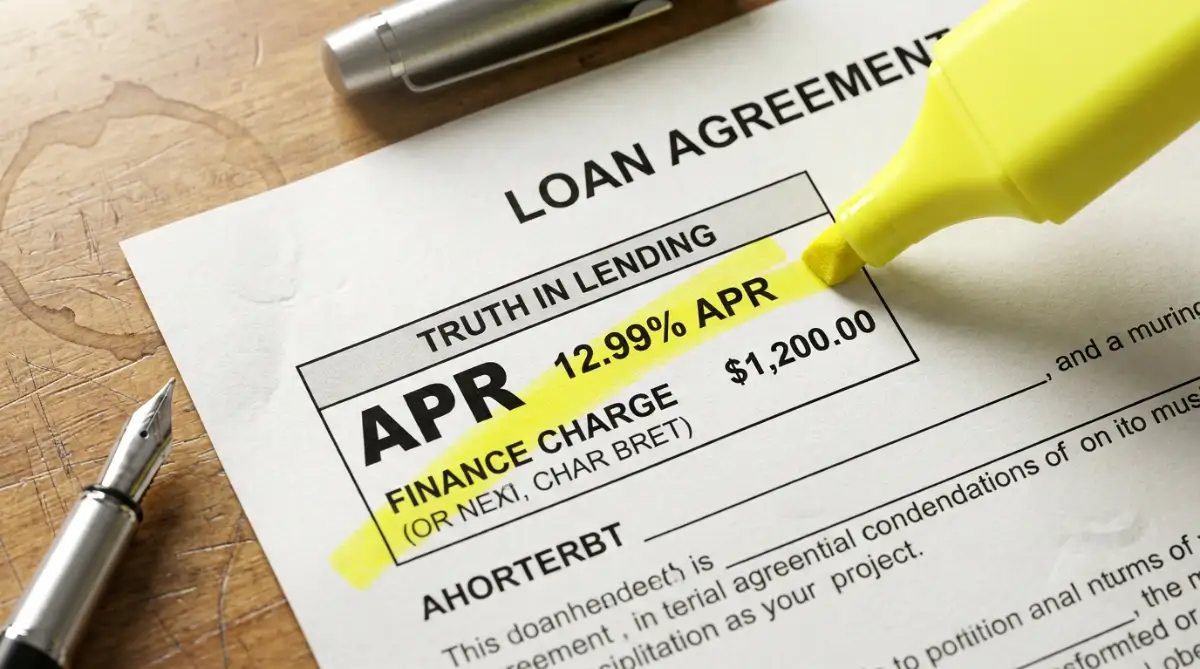
Always check the Annual Percentage Rate (APR) listed in this box. Keep these two rules in mind:
-
APR includes fees: The APR will almost always be higher than your base interest rate because it lumps in all the extra hidden charges.
-
Watch the gap: If the APR is massively higher than the rate the officer verbally promised you, stop reading immediately. Point directly to that number and ask them to explain the gap.
Verifying the Total Cost
Next, look for the line that says "Total of Payments." This number shows you exactly how much money you will have paid by the time the debt is completely cleared.
Seeing this massive number can be a shock, but it is necessary. It forces you to confront the reality of the interest charges. If that total number makes you feel sick to your stomach, it is a clear sign that you need to push harder for better terms.
Check the payment schedule as well. Ensure that the monthly amount matches exactly what you budgeted for at home. Even a small discrepancy of a few dollars means something in the math has changed behind your back.
Mastering Pro-Level Bargaining Strategies
One of the most powerful things you can do is time your application perfectly. Bank employees are just like any other sales professionals. They have monthly, quarterly, and annual quotas they must hit to earn their bonuses.
If you walk into a branch on the 28th or 29th day of the month, you hold a massive advantage. The loan officer might be just one or two approvals away from hitting their target. Because they are highly motivated to close the deal quickly, they are much more likely to bend the rules and offer you a heavy discount.
Leveraging the Risk Factor
Every single decision a lender makes comes down to one simple word: risk. If they view you as a high-risk customer, they will charge you a premium price to protect themselves. Your main goal is to aggressively lower your perceived risk in their eyes.
You can do this by proving you have excellent cash flow. Before you even walk into the office, you should know exactly how to calculate your debt to income ratio for loan approval. When you can confidently tell a banker exactly what your ratio is, their jaw will drop.
They are us