
The Frustrating Reality of Getting Ignored by Search Engines
95% of new blogs get zero traffic in their first year. You spend late nights writing massive 3,000-word guides, hit publish, and wait for a flood of visitors that simply never show up. I built my first site thinking high search volume meant guaranteed success. It took months of flatline analytics to realize I was making a massive mistake: I was trying to fight billion-dollar corporations for the exact same words.
If you are tired of checking your stats only to see silence, you need to change your target. Stop writing for the masses and start answering the incredibly specific, quiet questions real people are typing right now.
Actionable Takeaways Before You Read:
- Stop chasing big keywords; focus on highly specific, low-volume phrases that big sites ignore.
- Use the search engine's free autocomplete feature to find exactly what real people are asking.
- Group similar long-tail questions into one incredibly helpful, single article.
- Always match the user intent—don't write a history lesson when they want a buying guide.
Escaping the High-Competition Trap
The secret to breaking out of this invisible cycle is shifting your focus to highly specific phrases. These are the hidden gems that massive websites ignore because the monthly search volume seems too small for them. But for a growing blog, these highly specific questions are your golden ticket to the first page.
When you target a specific phrase, you are talking directly to a person who knows exactly what they want. For example, instead of guessing what a user wants when they type "shoes," you know exactly what they need when they type "best running shoes for flat feet on concrete." The intent is crystal clear, making it incredibly easy to provide the perfect answer.
You do not need an expensive monthly subscription to find these targeted phrases. The biggest search engines actually hand this data directly to you for free, if you know exactly where to look. They want to connect content creators with users, so they leave a trail of breadcrumbs for you to follow.
The Autocomplete Goldmine Strategy

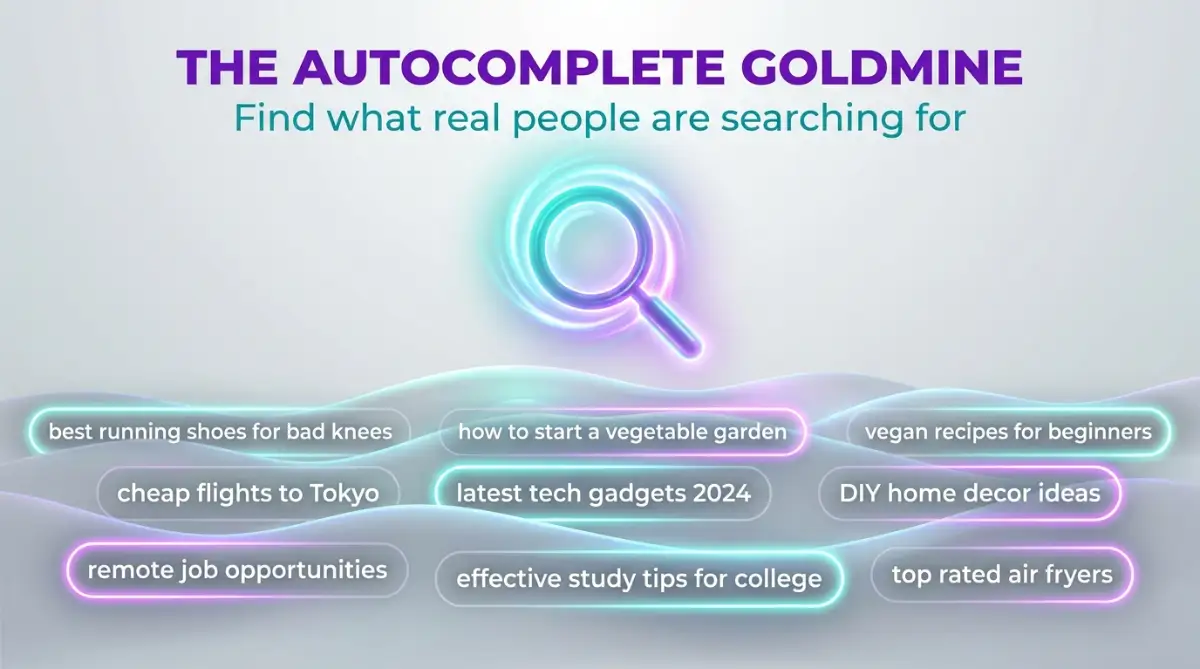
The absolute best free tool you can use is the search bar itself. Think of the search engine as a giant, incredibly smart librarian who remembers every question anyone has ever asked. When you start typing a single word, that librarian immediately tries to guess the rest of your sentence based on what millions of other people are asking.
Start by opening an incognito or private browsing window on your computer. This ensures your past search history does not influence the suggestions you are about to see. Type your main topic into the search bar, but do not press enter just yet.
Take a close look at the drop-down menu that appears instantly below your typing. You will see a list of longer, very specific phrases that real humans are typing right now. These predictions are guaranteed to have search volume, because the algorithm only suggests phrases that have a proven history of being searched.
The Alphabet Soup Technique
To take this a step further, you can use a method called the alphabet soup technique. Type your main topic, hit the spacebar, and then type the letter "a". The drop-down will now show you long phrases starting with "a".
Document those phrases, delete the "a", and type the letter "b". Repeat this process through the entire alphabet. You will suddenly have hundreds of highly specific, extremely targeted ideas for your next blog post.
Quick QA: Filtering Your Keyword Mess
- Q: I just found 200 phrases using the alphabet technique. Do I write 200 posts?
- A: No! Group them by intent. If someone searches "can dogs eat green apples" and "can dogs eat red apples," they just want to know if apples are safe. Put all of that into one master guide titled "The Ultimate Guide to Feeding Your Dog Apples safely."
Pro Tip: I used to think I needed to write a massive, separate article for every single variation I found in the search bar. My biggest realization was that you can group similar questions together and answer all of them inside one incredibly helpful, comprehensive guide.
Extracting Gold from the "People Also Ask" Box
Once you actually hit enter on a search, you will usually see a small box titled "People Also Ask" near the top of the page. This feature is literally the search engine telling you exactly what related questions users have on their minds. It is a direct window into the thoughts and struggles of your target audience.
When you click the small arrow next to one of these questions to read the answer, something amazing happens. The algorithm instantly generates two or three more related questions at the bottom of the list. You can keep clicking these arrows to create an endless loop of highly specific questions.
These questions make perfect subheadings for your blog posts. If you answer these exact questions clearly and accurately in your content, you highly increase your chances of appearing in those exact boxes. It is a proven, completely free way to grab attention and drive targeted readers to your site.
Ready to see this strategy in action? Watch this brilliant breakdown before reading further:
Understanding the "Searches Related To" Section
Scroll all the way down to the very bottom of the first page of results. You will find another list of clickable links under a heading like "Related searches." These are phrases that are closely tied to your original query, but they might approach the topic from a slightly different angle.
Often, you will find modifiers added to your main topic here. Words like "for beginners," "near me," "free," or "step by step" frequently appear in this section. Adding these specific modifiers to your ideas is a incredibly smart way to create long-tail phrases that convert well.
Make it a habit to copy this entire list and paste it into a simple text document. Over time, you will build a massive library of topics that you know your audience actually cares about. You can then organize this list and start planning your content calendar around these proven ideas.
Myth vs Reality: The Search Volume Trap
The Myth: You should only target phrases that get tens of thousands of searches every single month.
The Reality: High volume usually means impossible competition. Getting 100% of the traffic from a phrase with 50 monthly searches is far better than getting 0% of the traffic from a phrase with 50,000 monthly searches.
Those smaller, specific phrases add up incredibly fast. If you write twenty articles that each bring in 50 targeted visitors a month, you now have a steady stream of 1,000 highly engaged readers. These readers are much more likely to trust you, click your links, and share your content because you answered their exact question perfectly.
Harnessing Free Keyword Generator Tools
While the main search bar is fantastic, sometimes you want a tool to organize the data for you quickly. There are several powerful software platforms that offer generous free daily limits. You can use these to speed up your research process without ever pulling out a credit card.
Platforms like AnswerThePublic allow you to enter a single word and instantly generate a massive visual map of questions. It groups ideas by who, what, where, when, why, and how. This gives you a clear picture of the exact problems your audience is trying to solve.
Even though the free version limits how many times you can search per day, it provides more than enough data for a beginner. Always export the data to a spreadsheet so you can save it and review it later. You can build an entire year of content ideas with just a few free searches on these platforms.
Mining Social Forums for Raw Language
To truly understand your audience, you need to see how they talk when they are asking for help. Websites like Reddit and Quora are absolute goldmines for discovering long-tail phrases. People go to these forums to ask detailed, specific questions that they cannot find answers to anywhere else on the internet.
Go to an industry-relevant forum and search for your main topic. Look for threads that have hundreds of upvotes and dozens of comments. Read through the original post and pay close attention to the exact words the person uses to describe their problem.
You will often find phrases that you would never think of on your own. People use natural, conversational language when they are frustrated and looking for a solution. Using this exact natural language in your article titles makes your content incredibly relatable and highly clickable.
Quick Reality Check: What Most Beginners Get Wrong
- The Common Myth: You need expensive paid tools like Ahrefs or SEMrush to find keywords that actually make money.
- The Hard Fact: Paid tools only show you what has happened in the past. Free autocomplete features (like Google and Pinterest search bars) show you exactly what real human beings are typing today.
The Broad vs Long-Tail Comparison
To make this concept absolutely clear, let us look at a simple breakdown of how different phrases perform. Understanding this difference is exactly how you stop wasting time and start getting results.
As you can see, the specific phrase might get fewer searches, but the person typing it knows exactly what they want to achieve. If you own a marketing agency for bakeries, that specific phrase will bring you an actual paying client. The broad phrase will just bring you students looking for a Wikipedia definition.
Real-World Example: The "Coffee Maker" Test
Let's see how this actually works if you are starting a coffee blog today.
Organizing Your Discovered Gems
Once you have gathered all these amazing, specific phrases using the free methods above, you need to organize them logically. Do not just start writing randomly. You need a simple system to track your ideas and ensure you cover every angle of your niche.
Create a basic spreadsheet with columns for the keyword, the estimated intent, and the article format. The intent could be informational, meaning they just want to learn something. Or it could be transactional, meaning they are ready to make a decision and take action.
Matching the article format to the intent is the secret to ranking. If the user is asking a "how to" question, your article must be a step-by-step tutorial. If they are asking for the "best options," your article needs to be a detailed comparison list.
When you align your content perfectly with what the user expects to see, search engines reward you with higher rankings. They track how long people stay on your page and whether they found your answer helpful. Providing a direct, clear answer to a specific long-tail question guarantees a great user experience.
Leveraging Pinterest Trends for Visual Search

Many people forget that Pinterest is actually a massive visual search engine, not just a social media platform. Millions of people use it every day to plan their lives, learn new skills, and find inspiration. Because of this, it is an incredible place to find specific phrases that people are eager to learn about.
Just like the major text-based search engines, Pinterest has a highly effective autocomplete feature in its search bar. Type in a broad topic related to your niche and look at the colorful bubbles that appear right below the search bar. These bubbles represent the most popular long-tail modifiers people are adding to your topic.
If you click on one of those bubbles, it adds that specific word to your search and generates a new set of related modifiers. You can easily drill down three or four levels deep to find extremely specific, highly targeted content ideas. Because Pinterest users are highly motivated to take action, these phrases often have incredible conversion rates.
Taking Your Search Intent Strategy to the Next Level
Finding the exact words your audience uses is only the beginning of your journey. To truly dominate the search results, you must understand how to weave those specific phrases into your content naturally. The days of simply repeating a phrase ten times on a page are completely gone.
Search engines today are incredibly smart and focus heavily on the overall context of your article. They read your blog post just like a human would, looking for true value and expertise. This means you have to organize your ideas logically and answer the user's hidden questions before they even ask them.
One of the smartest strategies you can use is creating a "topic cluster" around your main subject. Instead of writing fifty random posts about entirely different things, you write five highly detailed posts that all connect together. This shows the search algorithms that you are a true authority on that specific subject.
Organizing Your Content Like a True Expert
Imagine you run a website teaching people how to use modern design software. A broad, terrible keyword to target would be something generic like "digital art tips." The competition is fierce, and the user's goal is entirely unclear.
Now, compare that to targeting a highly specific, painful problem your readers are facing every day. For example, providing a step-by-step tutorial on how to fix deformed AI hands and faces directly answers a massive frustration. You immediately become their hero because you solved a highly specific issue they were struggling with.
When you create content like this, you should internally link your related articles together. If someone is reading your guide on fixing hands, they probably need help with image clarity as well. You can smoothly introduce another helpful guide explaining why your AI images look blurry and how to fix them fast.
The Science of User Retention and Readability
Getting someone to click your title on the search results page is only half the battle. Once they land on your website, you have exactly three seconds to convince them to stay. If they hit the back button immediately, search engines notice this and will quickly drop your ranking.
According to massive usability studies published by the Nielsen Norman Group on web reading behavior, most users do not read long blocks of text. Instead, they scan the page looking for bold words, bullet points, and clear subheadings. Your formatting is just as important as your actual writing.
Keep your paragraphs incredibly short, preferably no more than two or three sentences. Use plenty of white space so the text feels light and effortless to read, especially on mobile devices. A clean, beautiful layout tells the reader that you are a trusted professional who values their time.
Utilizing High-Quality Visuals for Better Rankings
Many beginners completely ignore the power of image optimization when planning their strategy. Google Images is actually the second largest search engine in the entire world. Naming your image files correctly can bring you hundreds of extra visitors every single month.
When you upload a picture, never leave the file name as "IMG_9942.jpg." Rename it using your specific long-tail phrase, using hyphens instead of spaces. Then, write a natural, descriptive sentence in the Alternative Text (Alt Text) box explaining exactly what the image shows.
The visual quality of your site also builds massive trust with your audience. Poorly lit or messy images will make your readers assume your advice is also low quality. You must teach your audience to stop ruining your AI art with lighting mistakes by setting a great example with your own visuals.
Understanding the Algorithm's Mindset
Search engines operate on complex math, but their main goal is always to serve the human reader. They want to provide the most accurate, helpful, and safe information possible. Following the official Google Search Central guidelines for helpful content is the best way to ensure long-term safety for your site.
Understanding how search algorithms read your text is exactly like decoding generative AI. Both systems rely entirely on giving the machine the precise context and clear patterns it needs to understand your main goal.
Always focus on writing naturally for humans first, and let the specific search phrases act as your invisible framework. Do not force words where they do not belong. Read your sentences out loud; if it sounds awkward to your ears, it will definitely look spammy to the search algorithm.
Deadly Traps That Will Destroy Your Traffic Dreams
I have seen countless hard-working bloggers completely destroy their chances of success by making the same exact mistakes. You can spend eighty hours researching and writing an absolute masterpiece of an article. But if you fall into these common traps, your website will remain a ghost town permanently.
The Keyword Stuffing Nightmare
Years ago, marketers figured out they could trick the system by repeating their target phrase hundreds of times in white text. Some people still believe a milder version of this tactic works today, and they force their exact phrase into every single paragraph. This is called keyword stuffing, and it is a guaranteed way to get your site penalized or completely banned.
When you write like a robot, your human readers feel completely disrespected and instantly leave your page. This massive bounce rate signals to search engines that your content is terrible. You must prioritize natural conversation over mathematical repetition.
Ignoring the Searcher's True Intent
This is perhaps the most heartbreaking mistake I see new writers make on a daily basis. They find a great long-tail phrase with low competition and write a beautiful 3,000-word informational guide. But when you actually search that phrase, all the top results are online stores selling a product.
This means the user intent was purely transactional; people wanted to buy something, not read a history lesson. Search engines will never rank your informational blog post if the user is actively trying to make a purchase. You must always physically check the first page of results to see what type of content the algorithm prefers.
Neglecting Brand Consistency and Trust
People want to learn from recognized experts, not anonymous websites with messy formatting and broken links. If your content jumps randomly from topic to topic without any clear focus, readers will never return. Building authority requires a steady, predictable focus on one specific niche.
For example, creating a seamless experience across multiple guides is what makes a site truly memorable. If you help a creator master AI character consistency, they will trust you enough to bookmark your site for future problems. Every single article you publish must maintain the exact same level of high quality.
According to trust studies by the Stanford Web Credibility Project, users judge the legitimacy of a website based on its visual design in just milliseconds. If you want to see an example of a cleanly structured platform, you can check out sites like digitshopy to observe their clear category organization. Professionalism is not optional if you want people to take your advice seriously.
The "Write it and Forget it" Delusion
Many creators believe that once an article is published, their job is completely finished. They never look at their older posts again, assuming the internet will slowly do the work for them. This lazy mindset allows your competitors to easily steal your rankings with fresh, updated information.
Search engines absolutely love updated, relevant content that reflects current facts and modern solutions. Set a reminder in your calendar to review your best-performing articles every six months. Add new examples, fix outdated links, and answer new questions that have recently appeared in the search bar.
When you treat your blog as a living garden that needs constant pruning, your traffic will multiply naturally. Neglecting your old content is like throwing away money you already earned.

Your Blueprint for Endless Organic Traffic
You now possess the exact same strategies that highly paid marketing agencies use to grow massive websites. You know how to bypass the impossible competition and find the hidden questions real humans are asking every day. More importantly, you know how to avoid the deadly mistakes that cause most beginners to quit in frustration.
Building a profitable, high-traffic website does not require luck, expensive software, or a massive budget. It simply requires a deep sense of empathy for your reader and a willingness to answer their specific questions clearly. Every single highly targeted article you publish is a tiny digital employee working for you around the clock.
Over time, these specific long-tail articles combine their strength to push your entire website's authority higher. Suddenly, you will find yourself naturally ranking for those massive, competitive broad terms you originally dreamed of. It is a slow, steady climb, but the financial and personal rewards are absolutely life-changing.
Action Plan for Tomorrow Morning
Do not just read this guide and move on to another random tutorial on the internet. Knowledge without immediate action is just entertainment, and entertainment will not grow your website. Tomorrow morning, I want you to open a fresh, private browsing window and start testing these free tools.
Here is your exact morning checklist to get started:
Find just five highly specific, low-competition questions in your niche that genuinely help people. Create a simple outline for each one, ensuring you focus deeply on solving the user's core problem. Once you hit publish on that first properly optimized post, you will feel a massive surge of confidence.
Questions People Always Ask About Finding Specific Keywords
How long does it take to see traffic from long-tail keywords?
It entirely depends on the age and current trust level of your website. For a brand new blog, it typically takes about three to six months for search algorithms to fully trust and rank your pages. If your site is already established, a highly specific long-tail post can rank on the first page in just a few days.
Do I need to put the exact phrase in my main title?
Yes, placing the exact specific phrase in your main H1 title strongly signals what your article is about. However, you should make it sound natural and exciting rather than robotic. For example, instead of just "best blue shoes," write "The 7 Best Blue Shoes for Long Distance Running."
Can I target multiple specific phrases in one single article?
You absolutely should target multiple related phrases within a single comprehensive blog post. Group similar questions together and use them as your H2 and H3 subheadings throughout the text. This strategy helps you capture dozens of different search variations with just one high-quality article.
Is search volume actually important for new blogs?
For a brand new blog, you should completely ignore high search volume metrics and focus solely on low competition. A phrase with zero reported monthly searches in standard tools often brings in surprisingly steady daily traffic. Getting a few real visitors every day is much better than getting lost on page fifty for a massive keyword.
Will these free tools give me enough ideas for a whole year?
Yes, using search engine autocomplete and the "people also ask" features provides an infinite supply of ideas. Because human language is constantly evolving, new specific questions are generated by users every single hour. You will never run out of high-quality content ideas if you pay attention to these free suggestions.
Should I delete old posts if they do not rank well?
You should rarely delete old content unless it is completely irrelevant to your current niche. Instead, audit the post to see if you targeted a phrase that was too broad or competitive. Rewrite the article to target a much more specific, less competitive question, and update the publish date.
My journey transformed completely the day I stopped shouting into the void and started answering the quiet, specific questions people were desperately asking. I promise that if you focus entirely on genuinely helping one specific reader at a time, your traffic will eventually skyrocket. Keep pushing forward, trust this natural process, and watch your website grow into the authority it deserves to be!
Disclaimer: The information provided in this article is for educational and informational purposes only and does not constitute financial, legal, or professional SEO advice. Search engine algorithms change frequently, and individual results will vary based on website age, niche, and content quality. Always comply with the official terms of service and content policies of Google, AdSense, Facebook, Pinterest, and any other platforms you use to promote your website.