My Freezing Morning Nightmare: The Truth About Winter EV Driving
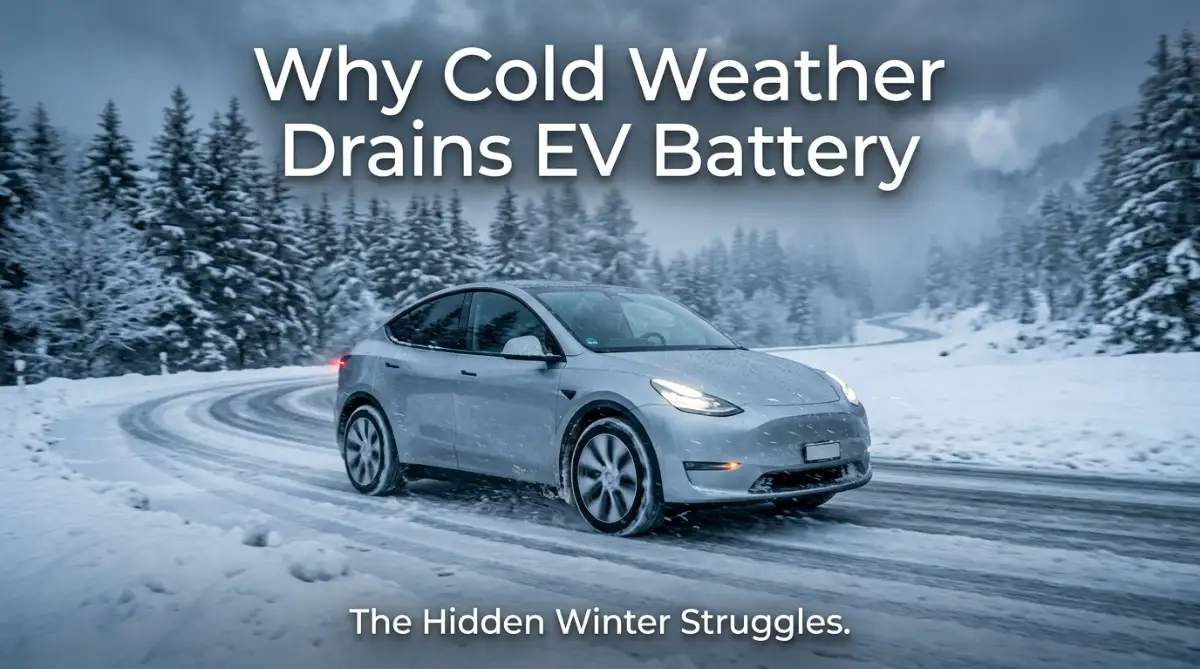
Let's be honest, staring at your EV dashboard on a cold morning and seeing half your expected range vanish is terrifying. You did everything right, plugged the car in overnight, and yet your battery acts like it’s running on empty. If you’ve ever found yourself shivering in the driver's seat with the heat turned off just to make it to work without running out of juice, you aren't doing anything wrong. Winter weather physically changes how your battery's chemistry works, but once you understand a few simple tricks, you can easily outsmart the cold and get your miles back.
Quick Winter EV Survival Guide:
- Warm up while plugged in: Always precondition your cabin using the mobile app while the car is still pulling power from your house.
- Skip the main heater: Rely heavily on your heated seats and steering wheel to stay warm without killing your battery.
- Check your tires: Cold air shrinks tire pressure, which increases road friction and steals your range. Check your PSI weekly.
- Use the native GPS: Let your car's built-in navigation map your route to the charger so it can pre-warm the battery on the way there.
What Actually Happens to Your Battery When the Temperature Drops?
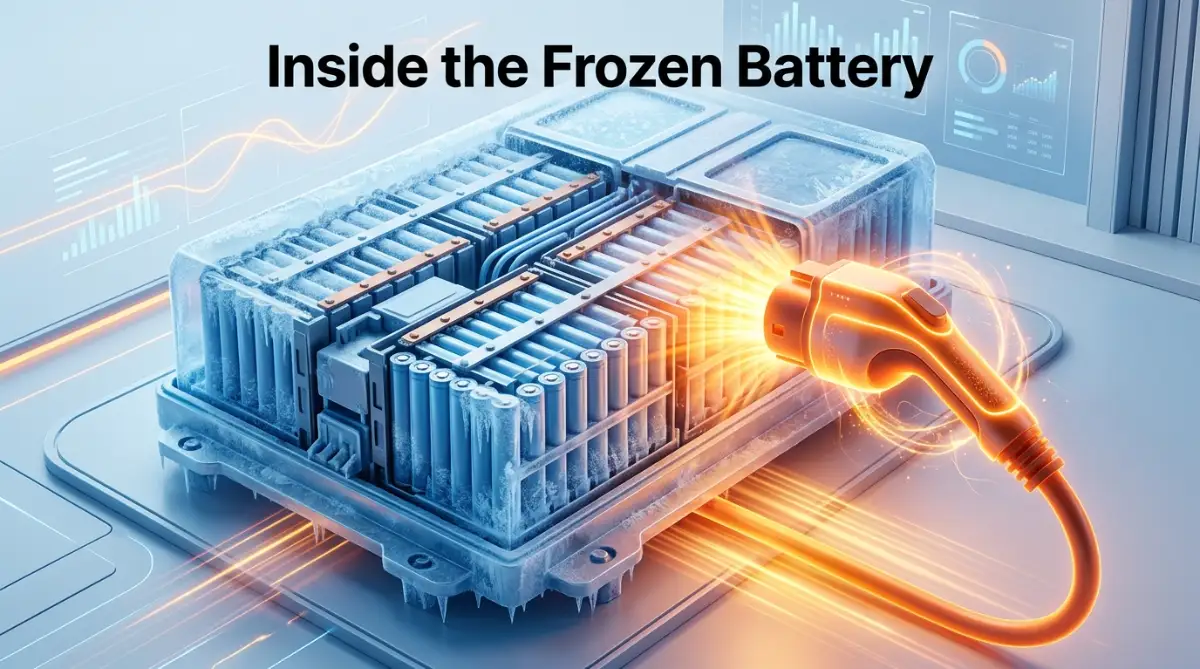
When the outside temperature drops below freezing, these chemical reactions slow down dramatically. Think of it like a human being trying to run a marathon in the freezing snow without a jacket. Your joints get stiff, your muscles move slower, and you spend a lot more energy just trying to stay warm.
The exact same physical reaction happens to the liquid electrolyte inside your car battery. The cold weather makes this liquid thick and sluggish, meaning the electrons cannot move back and forth easily. Because the internal resistance is so high, your battery simply cannot release its stored energy as efficiently as it does on a perfect summer day.
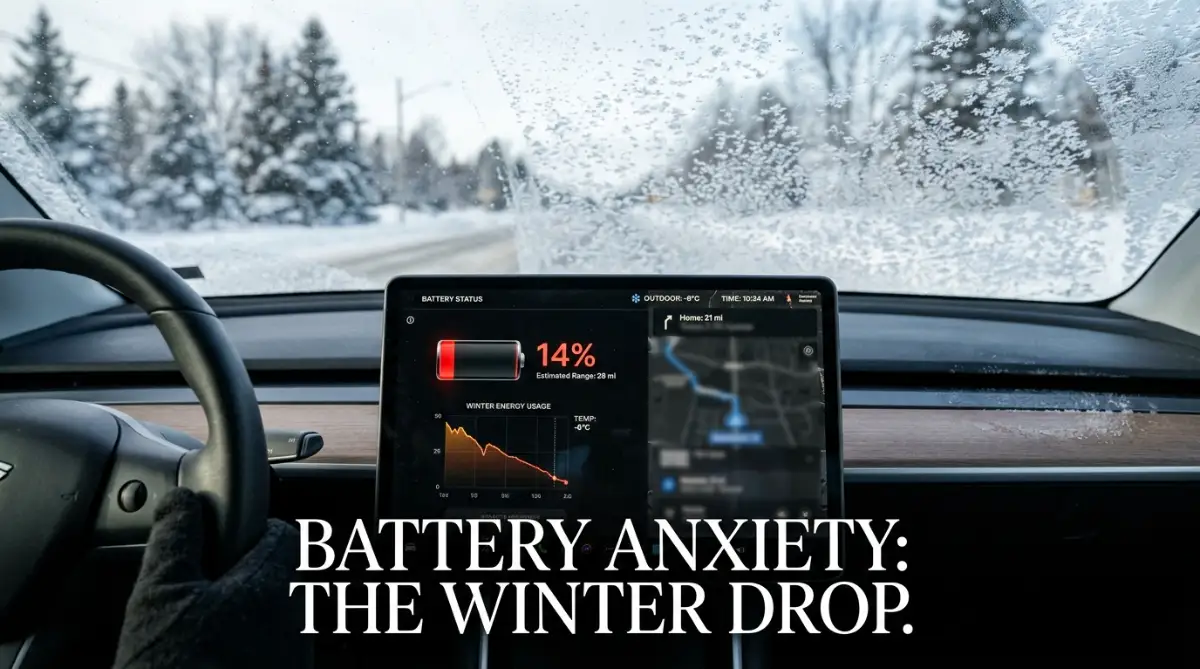
The Hidden Power Drain of Cabin Heating
One of the biggest reasons you lose so many miles in the winter has nothing to do with the actual motor. It has everything to do with keeping your physical body warm inside the car. In a traditional gas-powered car, the engine creates a massive amount of excess heat just by burning fuel.
Gas cars simply blow this free waste heat directly into the cabin to keep you warm and cozy. However, electric motors are incredibly efficient and do not produce enough extra heat to warm the interior. This means your electric vehicle has to use precious battery power to run an electronic heater or a heat pump.
Every time you turn up the heat, turn on the seat warmers, or defrost the windshield, you are actively stealing miles away from your wheels.
The Real Cost of Keeping Warm in an EV:
Here is a quick breakdown of how much energy different heating methods actually pull from your battery.
Want to see exactly how much power your heater is stealing? Watch this real-time test where an EV driver measures the massive energy drop the second the heat gets turned on.
I used to blast my cabin heater the second I got into my freezing car, draining nearly 10% of my battery before I even left my driveway. Now, I always pre-condition my car using the mobile app while it is still plugged into the charger at home. This simple habit saves my main battery power for actual driving, and my morning commute is so much less stressful.
Regenerative Braking Goes on a Winter Vacation
If you have driven an electric car for a while, you probably love the magic of regenerative braking. This amazing system takes the kinetic energy from a moving car and pushes it back into the battery when you lift your foot off the pedal. It essentially gives you free miles while you are slowing down in heavy traffic.
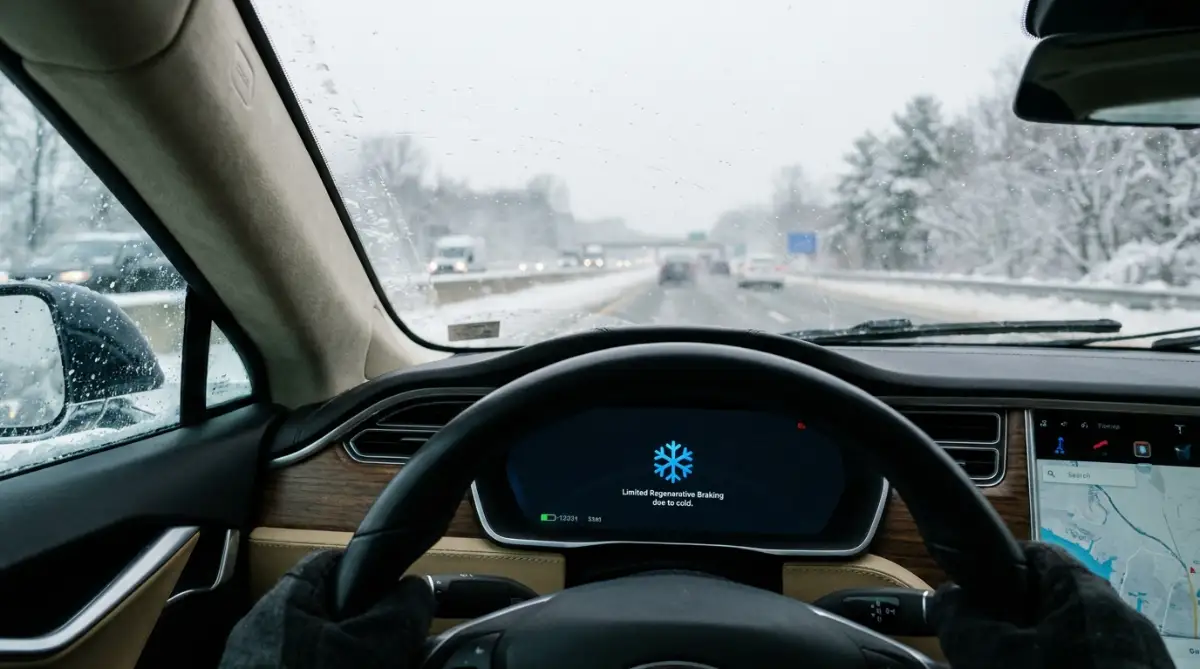
But cold weather completely disrupts this fantastic energy-saving feature. Because cold batteries cannot accept a fast incoming charge without getting severely damaged, your car’s computer intentionally limits regenerative braking. The vehicle is simply trying to protect the battery cells from taking in power too quickly when they are frozen and stiff.
As a result, you will notice your car coasting much further instead of slowing down automatically. You are forced to use the physical brake pads much more frequently during your winter drives. This means all that beautiful stopping energy is completely wasted as heat, instead of going back into your battery to extend your range.
Dense Winter Air Fights Against Your Car
Most people completely forget about aerodynamics when thinking about cold weather driving problems. Believe it or not, cold winter air is physically denser and heavier than warm summer air. The molecules in the freezing air pack closely together, creating a thicker invisible wall for your vehicle to push through.
When you drive down the highway at high speeds, your car has to work significantly harder to cut through this heavy air. This increased aerodynamic drag forces the electric motor to pull more electricity from the battery just to maintain a normal speed.
It is very similar to walking through knee-deep water versus walking on a dry sidewalk. The added resistance might seem invisible to your eyes, but your battery feels every single ounce of that extra pressure. If you do a lot of highway driving in the winter, this dense air is quietly stealing a large chunk of your daily range.
Tire Pressure Drops and Rolling Resistance Increases
You have probably noticed the low tire pressure warning light popping up on your dashboard during the first cold morning of the year. This happens because cold air condenses and takes up less physical space inside your tires. When the air shrinks, your tire pressure naturally drops, leaving you with softer, under-inflated tires.
Soft tires flatten out at the bottom and create a much larger contact patch with the actual road surface. This drastically increases something called rolling resistance, meaning the rubber drags harder against the pavement. Your electric motor has to push through this sticky friction every single time you press the accelerator pedal.
Checking your tire pressure is one of the easiest ways to fight back against winter range loss. Keeping your tires inflated to the exact numbers listed inside your driver’s side door will keep them firm and round. Properly inflated tires roll easily and smoothly, saving your battery from doing unnecessary heavy lifting on your daily commute.
Tire Pressure: Myth vs. Fact
- Myth: Lowering your tire pressure gives you better grip on winter snow.
- Fact: Deflating your EV tires only creates more rolling resistance and kills your battery range. Modern electric cars are very heavy, and their tires need to remain inflated to the exact factory specs (usually between 38 to 42 PSI) to cut through snow safely without draining extra electricity.
A Quick Look at Summer vs. Winter EV Performance
The Snow, Slush, and Road Friction Factor
Even if the sky is clear, the actual condition of the winter roads will force your car to work overtime. Driving through fresh snow, thick heavy slush, or icy patches creates an immense physical barrier for your tires. Your vehicle essentially turns into a miniature snowplow, using battery power to shove freezing water and ice out of the way.
Furthermore, when the roads are slippery, your tires often lose traction and spin uselessly for split seconds. Your car’s traction control system has to constantly adjust power to keep you driving safely in a straight line. Every tiny tire spin and every pile of snow you drive over demands extra electricity from the battery pack.
Battery Thermal Management Systems Working Overtime
Modern electric vehicles are incredibly smart and act very much like living creatures trying to survive the cold. They are equipped with highly advanced Battery Thermal Management Systems (BTMS) designed to keep the cells healthy. When the car realizes the battery is too cold to operate safely, it turns on its own internal heaters to warm the pack.
This means your car is pulling energy from the battery just to heat the battery itself. Your battery is doing double the work: sending power to the wheels to move the car, and sending power to the internal heaters to stay warm.
While this management system is absolutely essential for protecting the lifespan of your expensive battery, it eats up a massive portion of your daily range. It is a necessary sacrifice that the car makes behind the scenes. You lose some driving distance today so your battery can survive for many years down the road.
Slower Charging Speeds at Public Stations
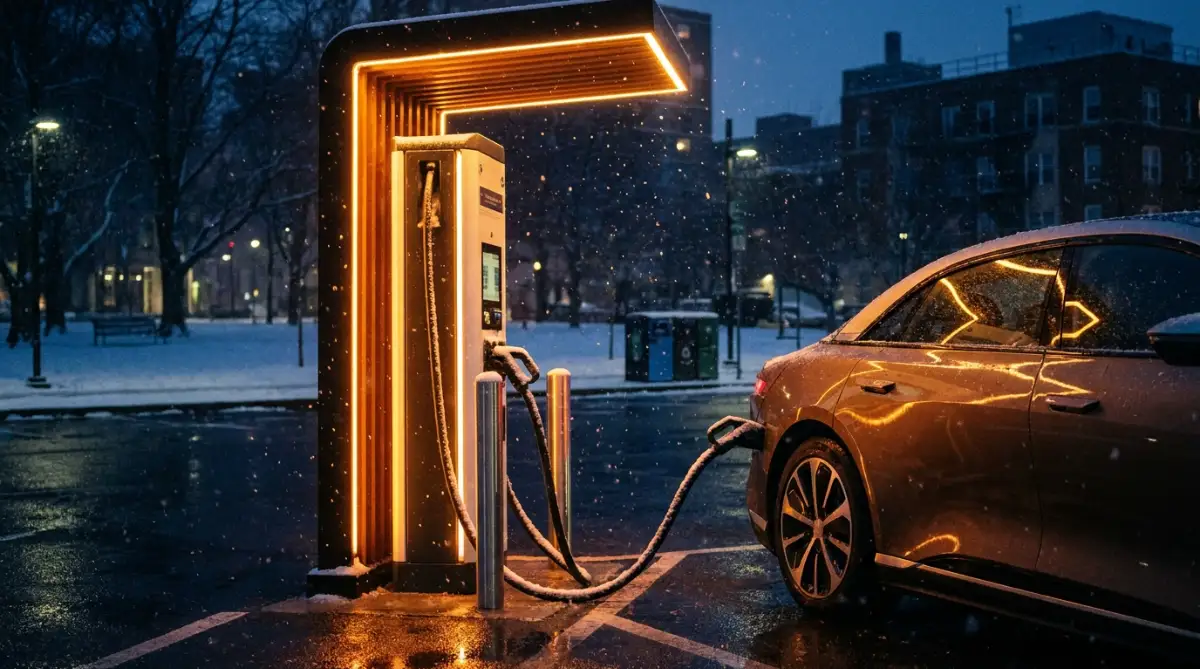
The effects of cold weather do not stop when you finally arrive at a public charging station. As we discussed earlier, cold lithium-ion cells simply cannot accept electricity at a fast pace. If you plug a frozen battery into a DC fast charger, the car will drastically slow down the incoming power to prevent permanent damage.
Instead of taking 30 minutes to reach an 80% charge, you might find yourself sitting in the cold for over an hour. The car will spend the first 15 to 20 minutes just using the charger's energy to warm up the battery pack before it even starts filling up the driving range.
This creates a highly frustrating experience during winter road trips, as every charging stop takes twice as long. Always try to navigate to a charger using your car's built-in GPS. Most modern EVs will automatically precondition and warm up the battery while you are driving there, ensuring you get the fastest charging speed possible the moment you plug in.
Myth vs Reality: Understanding Winter Driving
There are many confusing rumors floating around the internet about electric cars in the winter. Let us clear up a few of these common misunderstandings right now.
Myth: The cold weather permanently damages my electric battery capacity.
Reality: Cold temperatures only temporarily restrict the available power. Once the battery warms up in the spring, your full driving range naturally returns to normal. No permanent capacity is lost simply by being in the cold.
Organizations like AAA have tested cold weather EV performance extensively, proving that this range drop is completely temporary.
Myth: You should not charge your car to 100% in the winter.
Reality: While keeping it at 80% is good for daily summer use, many manufacturers recommend charging to 100% on freezing winter nights. This ensures you have plenty of buffer power to handle the heavy energy drain of the morning commute.
Myth: Electric cars are completely useless in snowy climates.
Reality: Because batteries are heavy and located at the bottom of the car, EVs actually have incredible traction and low centers of gravity. They handle amazingly well in the snow; you just have to plan for a slightly shorter driving distance.
Why Planning Ahead Changes Everything
When you fully understand the hidden science of cold weather battery drain, you stop being a victim to range anxiety. You realize that your car is not broken, and the battery is not failing you. It is simply physics, chemistry, and aerodynamics all working together against your vehicle at the exact same time.
By knowing exactly where your power is going, you can take smart, practical steps to stop the energy bleed. You can outsmart the cold weather by changing a few simple habits before you even leave your driveway. Driving an EV in the winter requires a slight mindset shift, but it is incredibly easy once you know the rules of the game.
Smart Strategies to Maximize Your Winter Range
Now that we deeply understand exactly why the freezing weather steals your energy, it is time to take back control. You do not have to just sit there and watch your battery percentage melt away on your morning commute. By changing just a few simple daily habits, you can drastically reduce this energy loss and drive with total confidence.
These are the exact same strategies I personally use to survive the bitter cold months without panicking about my battery. Let me share a few advanced secrets that will immediately change how you experience winter driving.
The Magic of Preconditioning While Plugged In
If there is only one piece of advice you take away from this guide, it needs to be this. You must get into the habit of warming up your car while it is still actively plugged into the wall charger at your house. This process is called preconditioning, and it is an absolute game-changer for your daily range.
When you use your phone app to turn on the heater thirty minutes before you leave, the car pulls electricity directly from your house. This means your battery stays completely full and beautifully warm before you even open the car door. If you start your drive with a warm battery, the car does not have to waste its own stored energy fighting the cold.
Heat the Human, Not the Air
Heating the massive volume of empty air inside a car cabin takes a tremendous amount of electrical power. Instead of blasting the main cabin heater to max power, try relying entirely on your heated seats and heated steering wheel. These direct-contact heaters use a tiny fraction of the electricity compared to the main air blower.
They warm up your physical body instantly, keeping you perfectly comfortable without draining your main battery pack. Think about it like wearing a heated jacket instead of trying to heat up an entire giant room. I completely changed my winter driving experience when I realized that heating my seat kept me warmer and saved me up to twenty miles of range.
Give Your Car a Warm Place to Sleep
Parking outside in the freezing wind overnight forces your car to use its own power just to keep the battery from freezing solid. If you have a garage, clean out those old cardboard boxes and actually park your electric vehicle inside during the winter. Even an unheated garage is significantly warmer than being exposed to the harsh, freezing wind chill outside.
If you are serious about optimizing your setup, you might want to look into how to prepare your garage for an electric car to ensure maximum safety and charging efficiency. A dry, enclosed space naturally protects your battery pack from those extreme overnight temperature drops. You will wake up to a healthier battery that is ready to perform at its best.
Rely on Built-in Navigation to Warm the Battery
Whenever you are heading to a public fast charger, you must use your car's built-in GPS screen to map the route. You might prefer using your smartphone for directions, but your car needs to know exactly where you are going. When the car realizes you are driving to a charging station, it will quietly start warming up the battery on the way there.
By the time you pull up to the plug, your battery will be at the perfect operating temperature to accept electricity quickly. If you just show up with a frozen battery, you will sit there forever while the charger slowly drips energy into the frozen cells. Recent official government testing on cold weather EV efficiency proves that arriving with a pre-warmed battery can literally cut your charging time in half.
Master the Winter "Eco Mode"
Almost every modern electric car has an "Eco" or energy-saving driving mode built into the software. While this mode might feel a bit slow and boring during the summer, it is your absolute best friend in the snow. Eco mode intentionally dulls the response of your accelerator pedal, stopping you from sending too much sudden power to the wheels.
This gentle power delivery serves two massive purposes for your winter driving experience. First, it stops your tires from spinning wildly on icy patches, keeping you safe and perfectly in control. Second, it aggressively saves battery power by forcing you to accelerate smoothly and slowly through heavy snow.
Winter Driving Traps That Quietly Destroy Your Battery
Learning what to do is important, but knowing what absolutely to avoid can literally save you from getting stranded on the side of a frozen highway. Many new electric car owners accidentally torture their vehicles because they treat them exactly like traditional gas cars. These common mistakes create massive headaches and unnecessary stress.
Let me walk you through the most dangerous winter habits I see people making, so you never have to experience these scary situations yourself.
The "I Will Just Charge It Tomorrow" Trap
We have all had those long, exhausting days at work where we just want to go inside and instantly fall asleep. You pull into the driveway, look at your dashboard, see 20% battery remaining, and think, "That is enough, I will just plug it in tomorrow." This is easily the most dangerous mistake you can make on a freezing winter night.
When your battery gets painfully cold overnight, the car uses that remaining 20% just to run the internal thermal management system. You might wake up the next morning to find your battery completely dead, refusing to even turn on. Always plug your car in every single night during the winter, even if you only drove a few miles that day.
Instead of crossing your fingers and hoping your car turns on the next morning, follow this simple overnight checklist:
- Plug in regardless of battery level: Even if you are sitting at 60%, plug that charger in.
- Let the house do the heavy lifting: Your car will use your home's electricity to keep its internal thermal management system running.
- Create a safety net: The wall power keeps the cells warm all night, so your battery never drops to freezing temperatures while you sleep.
Ignoring the Hidden Danger of Under-Inflated Tires
I cannot tell you how many people completely ignore that little yellow tire pressure warning light on their dashboard. As the cold air shrinks the pressure inside your tires, your car slowly starts dragging itself across the pavement. Driving on soft, under-inflated tires forces your electric motor to work twice as hard to maintain a normal speed.
It completely destroys your energy efficiency and eats away at your daily driving distance without you even noticing. According to comprehensive winter tire testing data, low tire pressure also ruins your grip on icy roads, making your car extremely dangerous to drive. Check your tire pressure every single week during the winter and keep a cheap portable air compressor in your trunk.
Relying Too Heavily on Fast Public Chargers
Public fast chargers are amazing for long road trips, but relying on them for your daily winter charging is a terrible idea. Blasting a freezing cold battery with massive amounts of electricity causes immense stress to the internal chemical cells. Even with thermal management systems working hard, cold batteries simply hate fast charging.
According to massive amounts of real-world data analysis of cold weather battery performance, slow overnight charging at home is dramatically healthier for your car during the winter. A slow, steady drip of energy generates a gentle warmth that naturally protects the battery over time. Only use the big public fast chargers when you are far from home and absolutely need them.
Misunderstanding the Limits of Regenerative Braking
Many drivers get totally caught off guard when their car suddenly behaves differently on a slippery road. You get so used to simply lifting your foot off the pedal and letting the car aggressively slow itself down. But when you are driving on black ice or packed snow, sudden regenerative braking can actually cause your wheels to lock up and slide.
Most experts actually recommend turning your regen settings down to "low" when driving in severe snowstorms. You want to maintain complete manual control over your brake pedal to prevent unexpected skidding on the ice. While it is true that figuring out how regenerative braking saves your battery is awesome for dry days, safety always comes first when the roads are completely frozen.
Forgetting to Clear Snow Off the Roof
This might sound like a simple aesthetic problem, but leaving a giant pile of heavy snow on your car roof is an energy killer. That snow adds significant physical weight to your vehicle, forcing the electric motor to pull more electricity just to move forward. More importantly, it completely destroys the sleek, aerodynamic shape of your car.
When you drive down the highway, that chunky pile of snow catches the heavy winter wind like a giant parachute. This massive wind resistance drains your battery remarkably fast. Always take an extra two minutes in the morning to completely brush off your roof, hood, and trunk before you start driving.
Your Action Plan for Confident Winter Driving
Driving an electric car in the bitter cold does not have to be a stressful, anxiety-filled nightmare. The cold weather is not an enemy that you have to constantly fight against; it is simply a condition you need to prepare for. Once you accept that you will temporarily lose some range, you can stop worrying and start enjoying the quiet, smooth ride.
By taking advantage of preconditioning, using your heated seats, and monitoring your tire pressure, you are already ahead of the game. You now have the exact knowledge needed to protect your battery and maximize every single mile of energy. It just takes a little bit of smart planning and a slight change in your daily routine.
I remember how terrified I was during my very first winter with an electric car, constantly watching the battery percentage drop. But once I applied these simple habits, my range anxiety completely disappeared, and I started trusting my car again. You absolutely have the power to master your winter commute starting today. So go plug in your car, set that morning departure schedule, and enjoy a perfectly warm, stress-free drive tomorrow!
Honest Answers to Your Cold Weather EV Questions
Does sitting in freezing traffic drain my battery fast?
Actually, sitting in traffic is where electric cars truly shine compared to gas cars. Since the motor is not running, the only thing drawing power is your cabin heater and radio. As long as you keep the heat at a reasonable level, you can sit safely in freezing traffic for many hours without draining much range at all.
Will my EV battery die completely if parked outside for a week?
No, your car is smart enough to protect itself from dying completely while parked. It will use a tiny amount of energy to keep the battery pack from freezing solid, usually losing just one or two percent of charge per day. Just make sure you leave it parked with at least a 50% charge if you are going away on a winter vacation.
Are electric cars actually safe to drive in deep snow?
They are incredibly safe and often handle much better than traditional cars in deep snow. The massive battery pack sits directly under the floor, giving the car a perfect center of gravity that prevents sliding. Combined with advanced traction control, an electric car with good winter tires is an absolute tank in the snow.
Should I cover my car with a tarp to keep the battery warm?
Putting a tarp over your car will keep the snow off the windows, but it does absolutely nothing to keep the battery warm. The battery is heavily insulated underneath the vehicle, and a thin tarp cannot trap any meaningful heat against the freezing ground. Your best option is simply keeping the car plugged into a wall outlet so it can manage its own temperature.
Do some electric cars handle the cold better than others?
Yes, vehicles equipped with a dedicated "heat pump" system perform significantly better in the cold than cars with basic electric resistance heaters. A heat pump works exactly like a reverse air conditioner, pulling ambient warmth from the outside air to heat the cabin very efficiently. If you live in a severely cold climate, buying a car with a heat pump will save you a massive amount of range.
Disclaimer: The information provided in this article is for educational and informational purposes only. Automotive performance, battery health, and driving range can vary significantly based on your specific vehicle model, driving habits, and local weather conditions. Always consult your official vehicle owner's manual or a certified automotive professional before making significant changes to your charging routines or driving habits.