The Reality of Searching for a Financial Lifeline
Over 70% of us are just one blown tire or sudden medical bill away from a totally empty bank account. When my car engine died right in the middle of the highway last year, panic completely took over. My savings balance was exactly zero. Out of pure desperation, I clicked the very first flashy "get cash now" ad I saw on my phone. I signed the forms without reading a single word, and that one rushed choice locked me into a brutal cycle of debt. It took me a full year of stress to finally break free. Let me show you exactly how to avoid the painful traps I fell into.
The sad truth is that the lending industry knows exactly how desperate you feel in these moments. Many companies design their offers to look like friendly lifelines when they are actually heavy anchors that will pull your finances underwater.
We often forget that borrowing money is a major financial transaction, even if it happens through a quick mobile app. We let the urgency of the moment blind us to the long-term math.
But you do not have to fall into the same painful traps that I did. By slowing down for just a few minutes and recognizing the common errors people make, you can protect your wallet and your mental health.
Quick Takeaways: What You Need to Know Right Now
-
Always check the APR: The monthly payment is a trick; the Annual Percentage Rate tells you the actual cost of your loan.
-
Use soft pulls only: Stop mass-applying. Only use lenders who offer pre-qualification with a soft credit check so your score stays safe.
-
Find the hidden fees: Scan your contract for sneaky terms like "origination fees" or "prepayment penalties" before you click accept.
-
Talk to your billers first: Often, a simple phone call to the hospital or utility company will get you a 30-day payment pause for free.
Smart Steps to Protect Yourself When Borrowing Fast Cash
When a financial disaster strikes, your first instinct is to get the money as quickly as possible. However, taking a deep breath and following a clear, logical path will save you from months of financial misery.
We need to look at the exact behaviors that turn a simple request for money into a long-term nightmare. Let us break down the absolute biggest errors you must avoid and what you should actively do instead.
Ignoring the True Price Tag of the Money
One of the most common things people do is focus entirely on the monthly payment while completely ignoring the Annual Percentage Rate (APR). Lenders love to highlight a low monthly payment to make the offer look incredibly affordable.
But a low monthly payment over a long period usually means you are paying a massive amount of interest.
The APR is the actual, true cost of borrowing the money, including the interest rate and any standard fees. If you only look at the monthly bill, you might end up paying back double the amount you originally borrowed.
For example, taking a small advance of $1,000 might seem harmless if the monthly payment is only $50. But if you are paying that $50 for three years because of a sky-high APR, that small advance becomes a very expensive mistake.
Always look for the APR in big, bold numbers before you agree to anything. Compare the APR of at least three different lenders to ensure you are getting a fair deal based on your current credit history.
Look at the bottom row. You borrow a thousand bucks, but you end up paying back almost three thousand. That is exactly why looking only at the "monthly payment" will destroy your bank account.
Before you sign any electronic agreement, use a free online calculator to see exactly how much total money will leave your bank account by the end of the term.
Sending Out Multiple Applications at the Same Time
When you need money quickly, you might think it is a smart strategy to apply everywhere at once to see who says yes first. This is a very logical thought process, but it is actually a terrible move for your financial health.
Every time you submit a formal application, the company performs what is called a "hard pull" or "hard inquiry" on your credit report. A hard pull stays on your record and temporarily lowers your credit score.
If you apply to five different places in a single afternoon, your credit score can drop significantly in a matter of days. When other lenders see multiple recent inquiries, they view you as a high-risk borrower who is desperate for cash.
This means the lenders who do approve you will likely charge you much higher interest rates to cover their perceived risk.
Instead of mass-applying, you should look for companies that offer a "pre-qualification" process. Pre-qualification uses a "soft pull" on your credit, which does not damage your score at all.
You can check your rates with several pre-qualification offers safely. Only submit a formal, final application when you are absolutely sure you want to move forward with that specific company.
Watch This Quick Video to Understand Hard vs. Soft Credit Checks Before You Apply:
Turning a Blind Eye to the Sneaky Fine Print
The biggest danger of applying for money on your smartphone is how easy it is to scroll quickly to the bottom and click "I Agree." Nobody likes reading pages of confusing legal jargon.
However, that boring document is exactly where predatory lenders hide their most expensive tricks. You must look for "origination fees," which are sneaky charges just for processing your paperwork.
Some companies will deduct the origination fee straight out of your funds. If you ask for $2,000 and they have a $100 origination fee, they will only deposit $1,900 into your account, but you still have to pay back the full $2,000 plus interest.
Another nasty trap is the "prepayment penalty." Imagine you get a bonus at work and want to pay off your debt early to save on interest. Some bad contracts will actually charge you a massive fee for paying them back too fast.
Always use the search function on your computer or phone to scan the contract for words like "fee," "penalty," and "deduction." If a company is trying to hide these charges, you should immediately take your business somewhere else.
Asking for More Than Your Exact Emergency Demands
When a screen pops up saying you are approved for $5,000, it is incredibly tempting to take the full amount, even if your broken water heater only costs $1,500 to fix.
You start thinking about using the extra money for a quick vacation, a new television, or catching up on other random bills. Taking extra money feels like a huge relief in the moment.
But every extra dollar you take is a dollar that will generate expensive interest every single day. You are essentially paying a premium price to buy things you do not actually need right now.
I learned this lesson the hard way a few years ago. I only needed enough to fix my transmission, but I took an extra thousand dollars just to feel safe, and the interest on that extra cash kept me broke for six additional months.
Calculate the exact penny you need to survive your current crisis, and absolutely refuse to borrow a single cent more than that number.
Falling for the "Guaranteed Approval" Scam
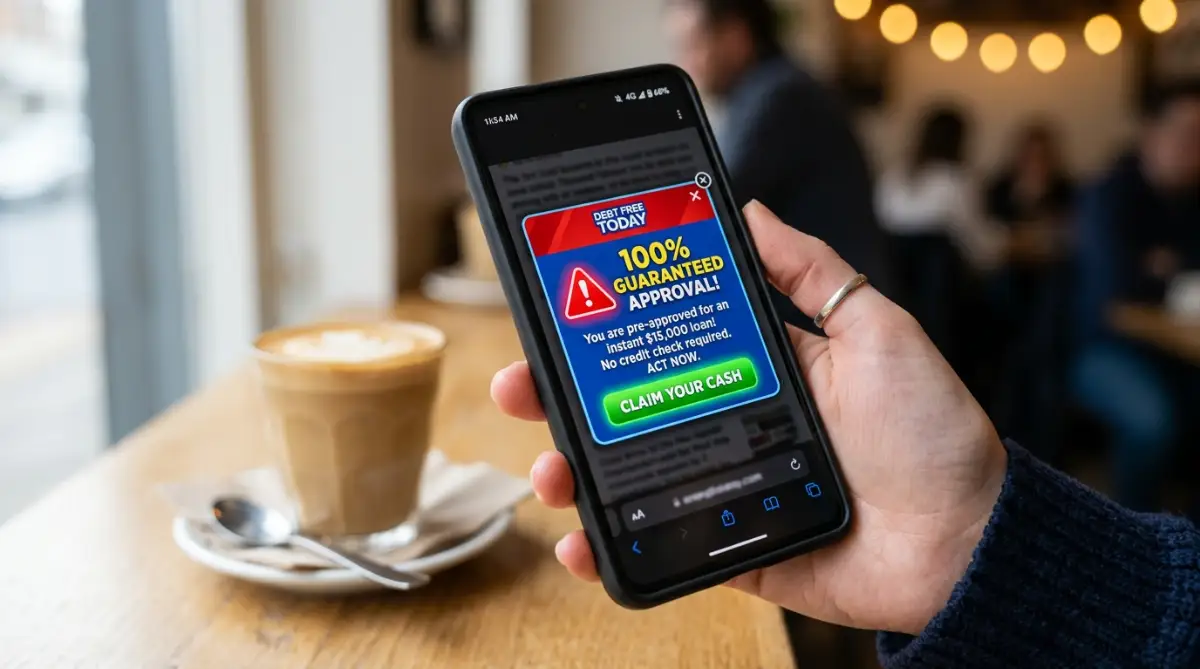
If you have a low credit score, you will naturally gravitate toward advertisements that promise you will be approved no matter what. Unfortunately, in the financial world, there is no such thing as a true guarantee unless it is a scam.
Legitimate lenders always have to evaluate risk. If a website promises 100% approval without checking any of your financial history, you are likely walking into a dangerous trap.
Many of these scams will ask you to pay an "upfront insurance fee" or an "advanced processing fee" before they release your funds. A real, legally operating lender will never ask you to send them money directly in order to receive money.
Scammers prey heavily on the panic of unexpected emergencies. They know you are not thinking clearly, and they use high-pressure tactics to make you act fast.
If someone calls you and aggressively demands that you pay a fee today using a gift card or a wire transfer, hang up the phone immediately.
Take a moment to verify the lender's physical address and check their reputation on independent consumer protection websites. A few minutes of simple research can save you from having your bank account drained by a fake company.
My Personal Scam-Spotter Checklist:
-
Did they ask for money first? If they want an upfront "insurance fee" via gift cards or wire transfers, it is 100% a scam. Legitimate lenders never ask you to pay money to get money.
-
Is there a physical address? Search their address on Google Maps. If it shows an empty parking lot or a random post office box, run away immediately.
-
Do they promise guaranteed approval? Nobody can guarantee an approval without looking at your basic numbers. If they do, they are just lying to get your personal data.
Common Myths vs. the Financial Reality
Sometimes the mistakes we make come from bad advice passed down by friends or family members. Let us clear up some of the most dangerous misunderstandings right now.
Understanding the difference between a myth and the truth gives you massive power over your financial choices. When you know the rules of the game, lenders cannot easily manipulate you.
Relying Too Heavily on High-Risk Options
When you are rushing, payday advance stores or title loan shops often seem like the easiest path. They are brightly lit, located right in your neighborhood, and hand out cash on the spot.
But these options are mathematically designed to keep you trapped in a cycle of borrowing. You end up taking out a second advance just to pay off the interest from the first one.
Before walking into one of these high-risk places, you must explore your community resources. Many local credit unions offer what are known as Payday Alternative Loans (PALs).
These are heavily regulated, safe options designed specifically to help people avoid predatory rates. The requirements are often very simple, and the interest rates are capped by law.
Even if a credit union takes one extra day to process your paperwork, that 24-hour wait is worth avoiding a 400% interest rate.
You can also reach out directly to the company sending you the unexpected bill. If it is a hospital or a utility provider, they will almost always prefer to set up a friendly payment plan rather than force you into high-interest debt.
Never assume that an expensive outside loan is your only option without negotiatin